Batu Caves Stairs Guide
The 272 rainbow steps at Batu Caves look easy, but Malaysia’s heat makes the climb tougher than expected. Here’s what to know before heading up to the Temple Cave.
The independent visit described here remains an option. A paid tour adds transport and a planned route.
Last updated: May 16, 2026
Batu Caves Staircase: Quick Facts
| Detail | Information |
|---|---|
| Total Steps | 272 concrete steps to the Temple Cave entrance |
| Elevation Gained | Approximately 100 metres above ground level |
| Original Construction | 1920 (wooden); replaced with concrete in 1940 |
| Rainbow Repaint | August 2018 – red, blue, yellow, green, orange sections |
| Climb Time | 10-20 minutes (varies with heat, fitness, crowd) |
| Difficulty | Moderate – steep, no shade, humidity exceeds 80% |
| Dark Cave Entrance | Left side at step 204 (currently closed) |
| Entry Fee | Free |
| Accessibility | No wheelchair access; escalator announced 2024, not yet built |
| Best Time to Climb | Before 8:00 AM on a weekday |
How Many Steps Does Batu Caves Have And What Are They Made Of?
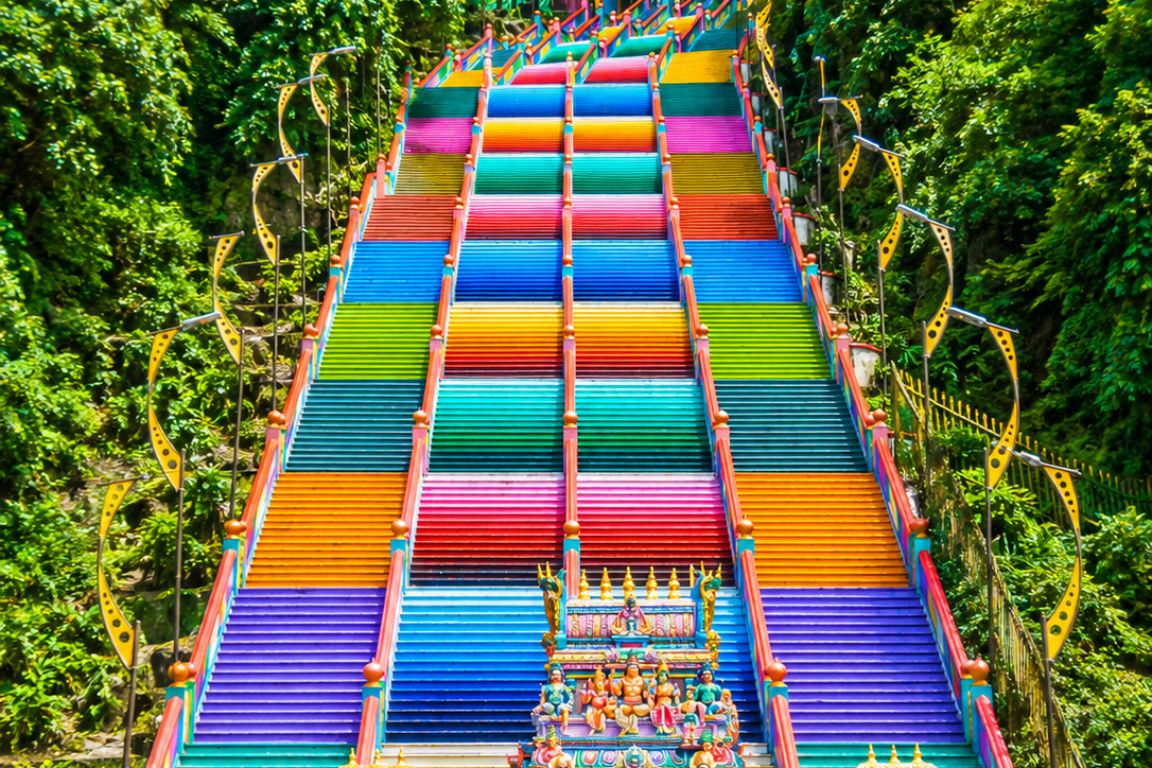 There are exactly 272 concrete steps leading from the base of Batu Caves to the entrance of the Temple Cave. The staircase gains approximately 100 metres in elevation. The current concrete structure was completed in 1940, funded partly by the temple selling land and partly by local workers donating a day’s wages – about 50 cents each – toward the construction. The steps were repainted in rainbow colours in August 2018.
Before the stairs existed, devotees climbed the steep limestone hill by gripping tree roots and rock faces. That was the only way up for anyone wanting to reach the cave temple in the century before 1920, when wooden steps were finally installed to make access safer, particularly for the kavadi carriers during Thaipusam who needed stable footing while bearing weight on their shoulders.
The wooden steps lasted two decades before tropical humidity and the weight of tens of thousands of annual footsteps wore them down. Temple chairman Ramachandra Naidu proposed a concrete replacement in 1939. The proposal went to the Secretary of the Resident of Selangor under the British Government of Malaya. Construction was approved, the temple sold five land lots on Batu Road in Kuala Lumpur to fund part of it, and the 272 concrete steps were ready in time for the 1940 Thaipusam festival. They have been in place ever since.
The rainbow paint came much later, and almost by accident. In August 2018, the temple was undergoing its kumbhabhishekam, a Hindu consecration ritual performed every 12 years to renew a temple’s spiritual energy. There was surplus paint left over from repainting the temple buildings. Around 100 volunteers painted the staircase over two and a half days, working through colour sections – red, blue, yellow, green, orange – that shift as you climb. The images went viral globally within days. The National Heritage Department noted the renovation had been done without the required heritage approval. The paint stayed, the steps are repainted each year before Thaipusam, and the rainbow staircase has become so identified with the site that it now appears on Malaysian tourism materials worldwide.
One detail most visitors don’t know: there are also approximately 101 additional steps inside the Temple Cave itself, leading to an inner chamber deeper in the limestone hill. The 272 is the public staircase. The experience doesn’t end at the top of it.
How Hard Is The Climb Up The Batu Caves Stairs?
 The climb is rated moderate. The step count alone is not the challenge – 272 steps is roughly equivalent to a 20-storey building. The challenge is doing it in Malaysia’s tropical climate, where humidity regularly exceeds 80% and midday temperatures on the open staircase hit 33°C or higher. Most reasonably fit adults complete the ascent in 10-20 minutes. Children above age 6 or 7 typically manage without difficulty. People with heart conditions or significant mobility limitations should take medical advice before attempting it.
The staircase deceives you. Standing at the base and looking up, the first section doesn’t look steep. It isn’t – the lower third is the gentlest part, wide and manageable, and your legs send back positive signals. The middle third is where the angle sharpens and the sun commits. There’s no shade on the open face of the limestone cliff. By step 130 or 140, if you arrived at 10 AM, you’re sweating through your shirt. By step 200, your legs are sending different messages.
The descent matters more than most people expect. Going down a steep concrete staircase in tropical heat, with legs already tired and possibly a wet surface underfoot from afternoon rain or dripping from the cave ceiling above, is where most slips and falls happen. Experienced guides tell visitors this every time: pace yourself going up, but pay more attention coming down.
Individual factors that make the climb easier: arriving before 8:00 AM when the steps are shaded and the air is twenty degrees cooler in practice; wearing proper footwear with grip rather than sandals; carrying water from the start rather than regretting it halfway; pausing at wider landings every 50-60 steps rather than pushing through and having to stop mid-step.
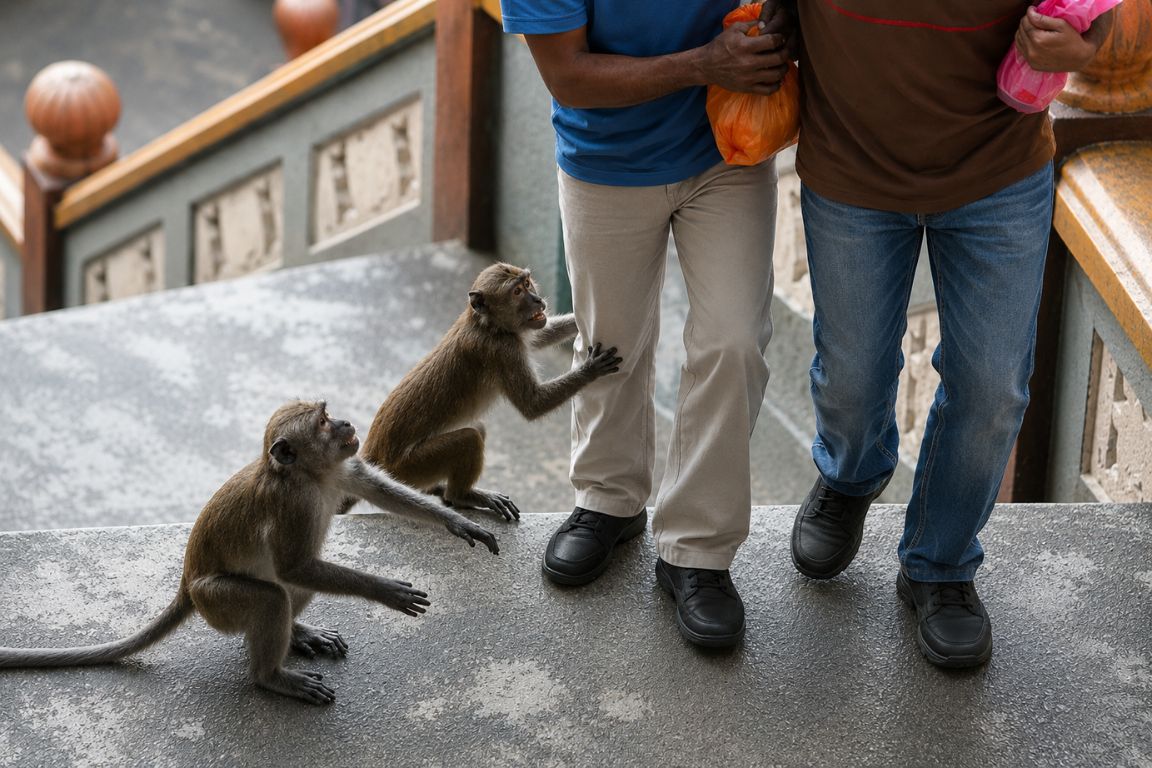
Individual factors that make the climb harder: midday heat (12:00-2:00 PM is the worst window by far); large crowds that slow movement and trap body heat; a bag that isn’t zipped, because the monkeys know exactly when you’re distracted.
Staircase Climb At A Glance: By Fitness Level
| Visitor Profile | Expected Climb Time | Key Consideration |
|---|---|---|
| Fit adult (any age) | 10-15 minutes | Heat and humidity still factor; bring water regardless |
| Average adult fitness | 15-20 minutes with breaks | Pause at wider landings every 50-60 steps; use railings |
| Older adults (60+) | 20-35 minutes with rest stops | Early morning strongly recommended; use both railings on descent |
| Children (7-12 years) | 15-25 minutes | Hold hands on descent; closed shoes essential |
| Children under 5 | Varies – parents’ judgment required | Consider a carrier for small children; steps are steep and uneven in places |
| Visitors with heart conditions or mobility issues | Not advised without medical guidance | Ground-level attractions (Ramayana Cave, temples) are accessible without the staircase |
What Do You See On The Way Up The 272 Steps?
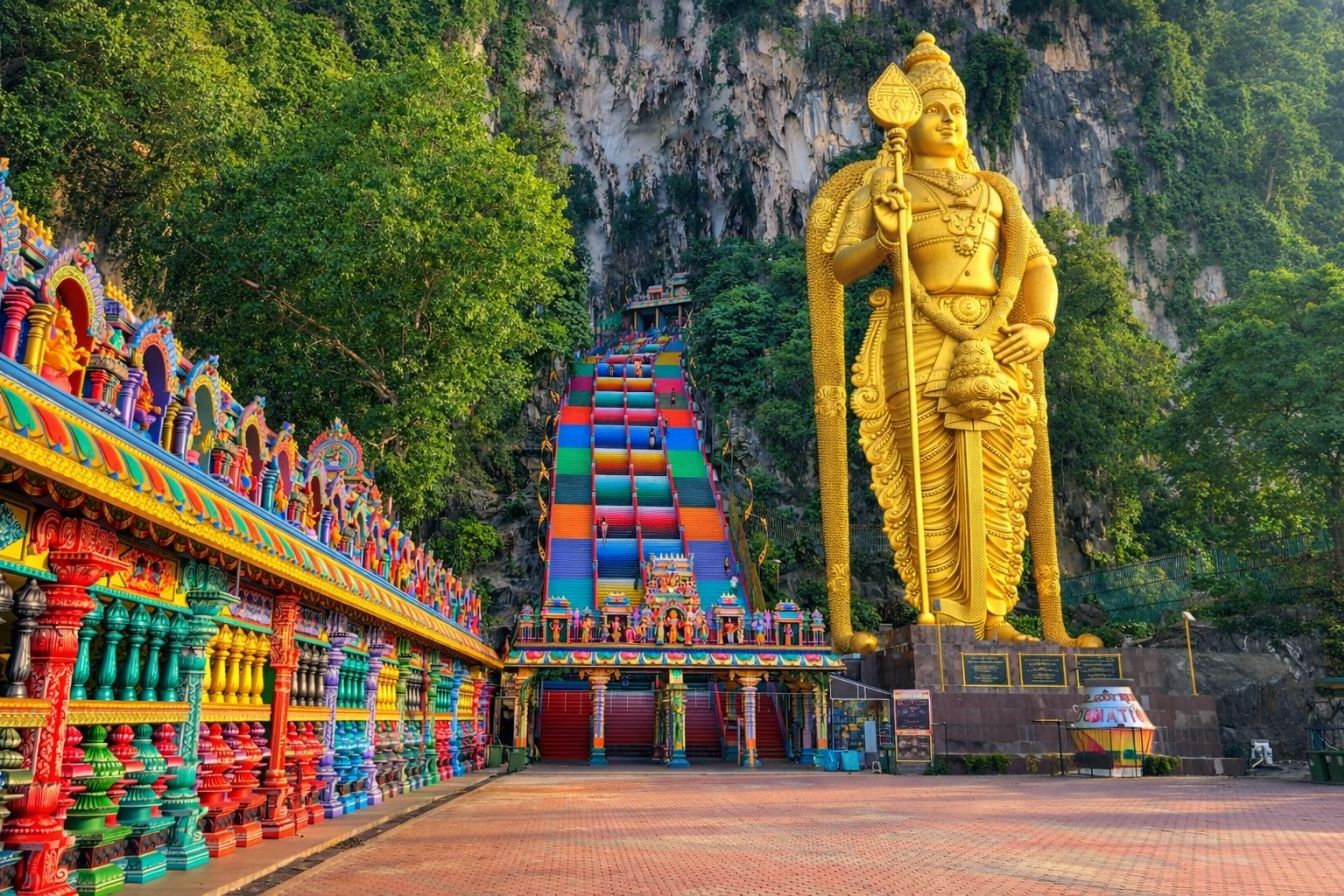 The staircase is not just a climb, it’s a sequence of distinct experiences. The first third gives you the full visual impact of the rainbow steps and the Lord Murugan statue rising to your right. The middle third passes through the densest monkey zone and reaches the closed Dark Cave entrance at step 204. The final third opens the cave mouth above you. From around step 180 on the descent, a look back down frames the forecourt, the golden statue, and the city of Kuala Lumpur in a view that most visitors miss entirely.
At the base, before step one, you’re standing in the forecourt with the 42.7-metre statue to your right. Look up along the staircase and the cave entrance sits level with the statue’s shoulders, maybe 100 metres above. The colours of the steps – red at the bottom, moving through orange, yellow, green, blue as you climb – don’t look as vivid in photos as they do with your feet on them.
Steps 1 to roughly 80 are the social stretch. This is where everyone takes photos. The view back down to the forecourt is already good, with the golden statue in the frame and the city visible beyond it on clear mornings. The monkeys are present here but relaxed – mostly watching, occasionally using the railings as a highway.
Steps 80 to 160 are where the heat finds you and the staircase stops feeling casual. The angle doesn’t change dramatically but the sun is fully on the steps now if you’ve arrived past 8:30 AM. This is also where the monkey behaviour shifts. More concentrated here, more purposeful. This is the section where bags get grabbed, where water bottles disappear from side pockets, where someone’s sunglasses get lifted off their head. Keep things zipped. Don’t eat anything.
At step 204, on the left, a gate marks the entrance to the Dark Cave. Currently closed, it was once the entry point to a protected cave ecosystem with over 2 kilometres of passages and 21 species of bats. Even closed, it’s worth a pause to look at. The limestone directly here is extraordinary – close enough to touch, ancient in a way that most people don’t stop to feel.
Steps 205 to 272 are the final push. The cave mouth is above you and growing. The air changes noticeably on the last thirty steps as the temperature drops and you begin to feel the cool from inside the limestone. At step 272 you don’t walk through a door. You step from daylight into a cathedral of rock, and then your eyes adjust and the ceiling rises and the scale of the Temple Cave becomes real.
Coming down: stop at around step 180 and look back over your shoulder. The staircase drops in colour below you, the golden statue stands at the forecourt to your right, and behind it the Kuala Lumpur skyline flattens out in every direction. It is an unusual view of an unusual city, seen from an unusual place. It takes thirty seconds and most people miss it completely.
Want to make sure you don’t miss the highlights while you’re there beyond just the main cathedral cave? Check out our what to see at Batu Caves tours guide before your visit.
How Long Does It Take To Climb The Batu Caves Steps?
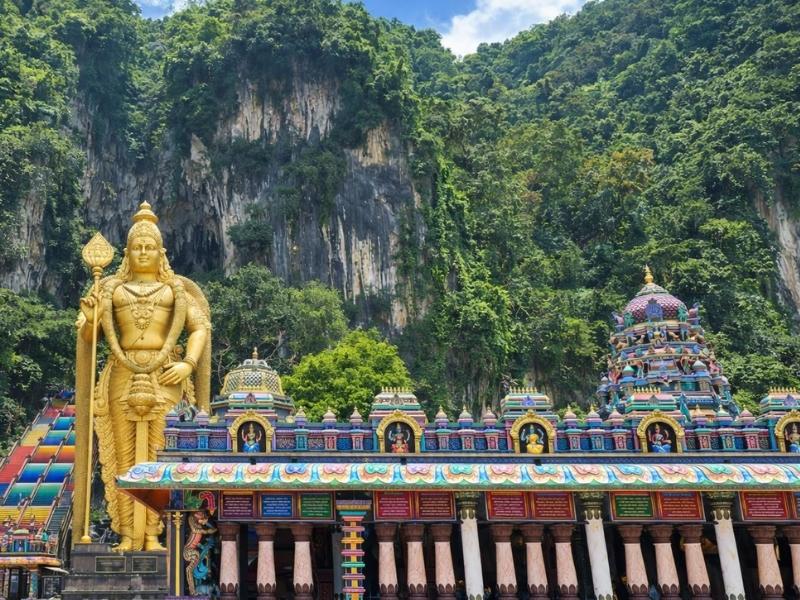
Most adults complete the climb in 10-20 minutes moving at a moderate pace with short rest stops. The descent takes roughly the same time, sometimes longer because the steepness requires more care. Total time for the staircase up and down, including a brief pause at the top, runs 30-45 minutes. Add another 45-75 minutes inside the Temple Cave for a full visit, and the total time on the stairs and in the cave is around 90 minutes to two hours.
The 10-minute figure applies to fit adults moving at a deliberate pace in the early morning. It’s not a sprint time – it’s what happens when someone arrives before the heat builds and walks steadily without stopping for photos or to manage the monkeys. At that speed, the climb is genuinely not difficult.
The 20-minute figure is more representative for first-time visitors arriving in mid-morning. The photo stops add time. The heat adds time. The occasional pause to watch a monkey do something ridiculous adds time. None of this is a problem unless you’ve told your taxi to come back in 45 minutes.
During Thaipusam, the timing question becomes irrelevant. On the festival’s main day, the staircase operates as a slow continuous procession and your pace is set by the crowd around you. It can take an hour or more to reach the top during peak flow. That’s not a delay – it’s the experience. The movement, the drums, the chanting, the devotees ascending around you – the pace is part of what you’re there to see.
What Should You Wear On Your Feet For The Batu Caves Stairs?
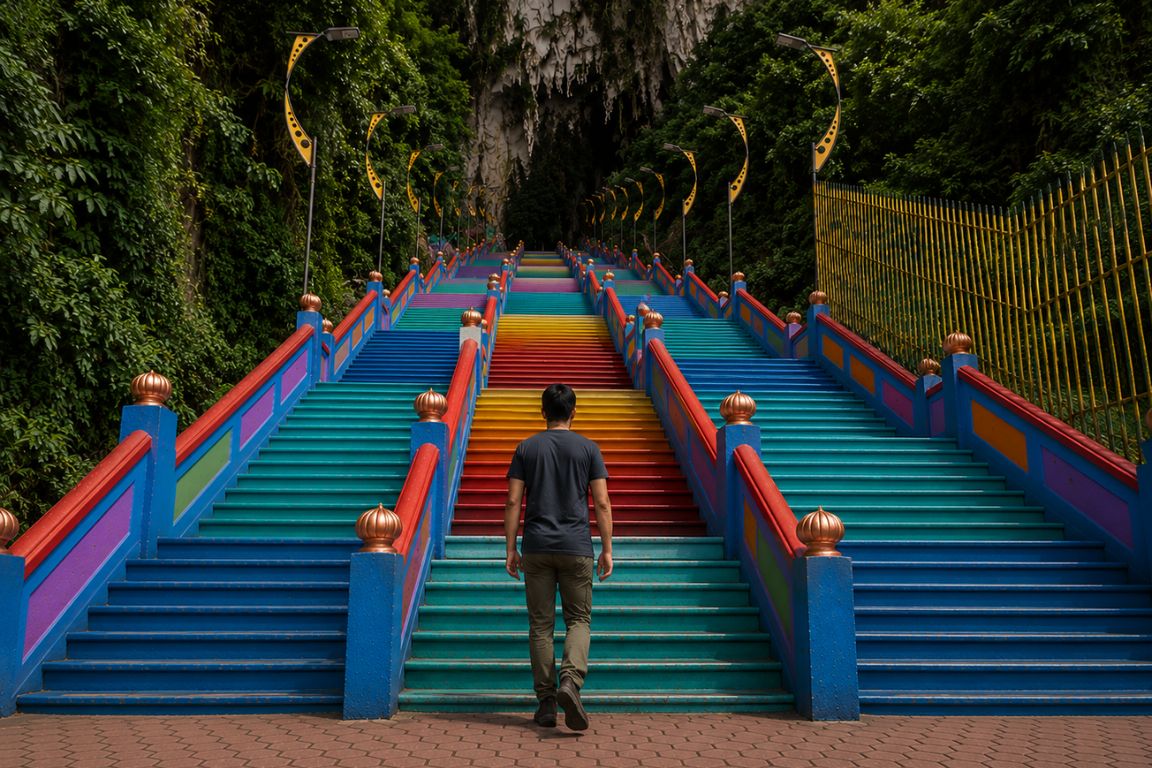 Closed shoes with rubber soles and a decent tread are the right choice. The concrete steps are steep, can be slippery after rain, and the Temple Cave floor at the top is uneven and often wet from ceiling drips. Flip-flops and strappy sandals are manageable going up on dry days but become dangerous on the descent, especially when wet. Most injuries on the staircase happen on the way down, not the way up, and most involve slippery footwear on damp steps.
This is the most consistently underestimated piece of preparation we see from visitors. People arrive in flat sandals because it’s hot and they’ve read that the dress code requires covered shoulders and knees, not covered feet. That’s true – footwear is not part of the temple dress code for the staircase. But the staircase itself doesn’t care about the dress code.
The specific problem: tropical rain falls unpredictably in Malaysia throughout the year, and the steps hold water longer than they look like they should. The painted concrete surface, while visually striking, offers less grip than bare concrete when wet. Add the angle of the descent and tired legs after a morning of climbing and cave-walking, and the risk profile for inappropriate footwear is real. We’ve seen it resolve badly.
A second consideration: you will need to remove your shoes when entering the ground-level temple buildings in the forecourt area. Sandals that slip on and off easily have an advantage here. The practical compromise is a sandal or shoe with a proper rubber sole and ankle support – something between a flip-flop and a hiking boot. Sport sandals with back straps work. Lightweight trail runners work better.
One clarification that comes up often: Hindu pilgrims, particularly during Thaipusam, sometimes climb the stairs barefoot. This is a personal devotional act, not a recommendation for tourists. Devotees climbing barefoot have prepared physically and spiritually for this. Tourists attempting it on impulse have not. Keep your shoes on.
Want to get the entry requirements right without overthinking what to wear in Malaysian heat? Here’s our Batu Caves tours dress code guide so there are no awkward surprises at the bottom of the stairs.
Footwear For The Batu Caves Stairs: What Works And What Doesn’t
| Footwear Type | Dry Conditions | Wet/Damp Steps | Verdict |
|---|---|---|---|
| Closed trainers / trail shoes | Excellent | Excellent | Best choice overall |
| Sport sandals with back strap | Good | Acceptable | Good compromise – easy to remove at temples |
| Flat sandals (no back strap) | Manageable going up | Risky on descent | Not recommended – especially for children |
| Flip-flops / thongs | Possible but unsteady | Dangerous | Avoid – descent risk is significant |
| Heels of any kind | Unsafe | Unsafe | Never appropriate for this climb |
When Is The Best Time To Climb The Batu Caves Steps?
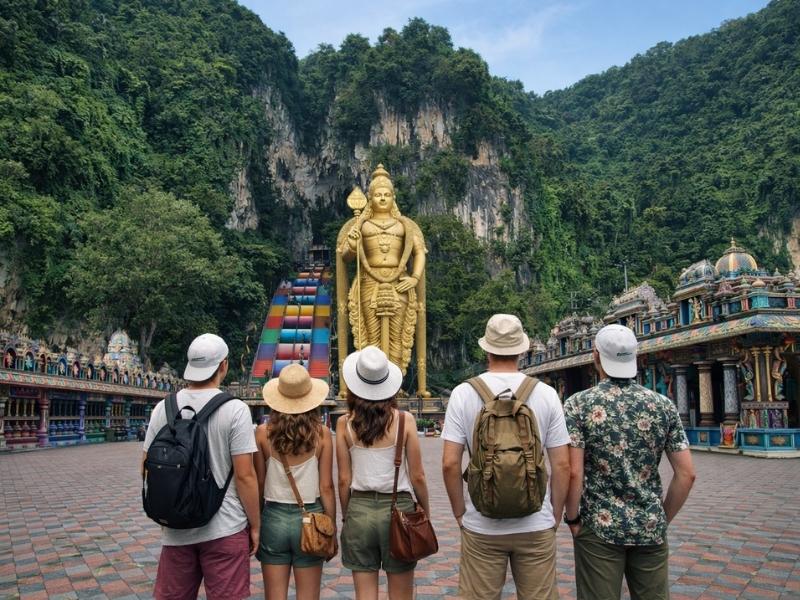
Before 8:00 AM on a weekday is the best window. The steps are partially shaded in the early morning, the air temperature is lower, and the staircase carries a fraction of the mid-morning crowd. By 9:30 AM the tour buses from Kuala Lumpur arrive and the steps become congested. Avoid 12:00-2:00 PM when the sun hits directly and heat exhaustion risk peaks. Late afternoon from 3:00-5:00 PM is a workable second option with softer light for photos.
The temperature difference between 7:00 AM and 11:00 AM on the staircase is not trivial. Malaysia’s heat builds quickly once the sun clears the limestone hill. Early morning the steps are still in shadow on the lower section and the air carries some of the night’s coolness. By 10:00 AM that coolness is gone and the concrete surface is actively radiating heat back at your feet.
Weekend timing deserves its own note. Weekends at Batu Caves are significantly busier than weekdays across all hours, but particularly from 9:00 AM onward. The staircase becomes two-way traffic at high density, which slows the climb, traps heat in the crowd, and makes the monkey situation more complex because there are more open bags and more distracted people. If a weekday is possible, take it.
Late afternoon is underrated. From around 3:00 PM to 5:00 PM on weekdays, the crowd thins as day-trip tour groups leave, the light turns golden and photographically interesting, and the cave interior at the top catches a warm low-angle light through its ceiling gaps around 5:00 PM that’s genuinely beautiful. The trade-off is afternoon rain, which arrives unpredictably and makes the steps slippery fast. Check the forecast and bring something waterproof if visiting after noon.
We’ve put together a full transport breakdown in our how to get to Batu Caves from Kuala Lumpur guide so you know exactly how to get there, how long it takes, and what to expect at each stage of the journey.
What Happens At The Batu Caves Stairs During Thaipusam?
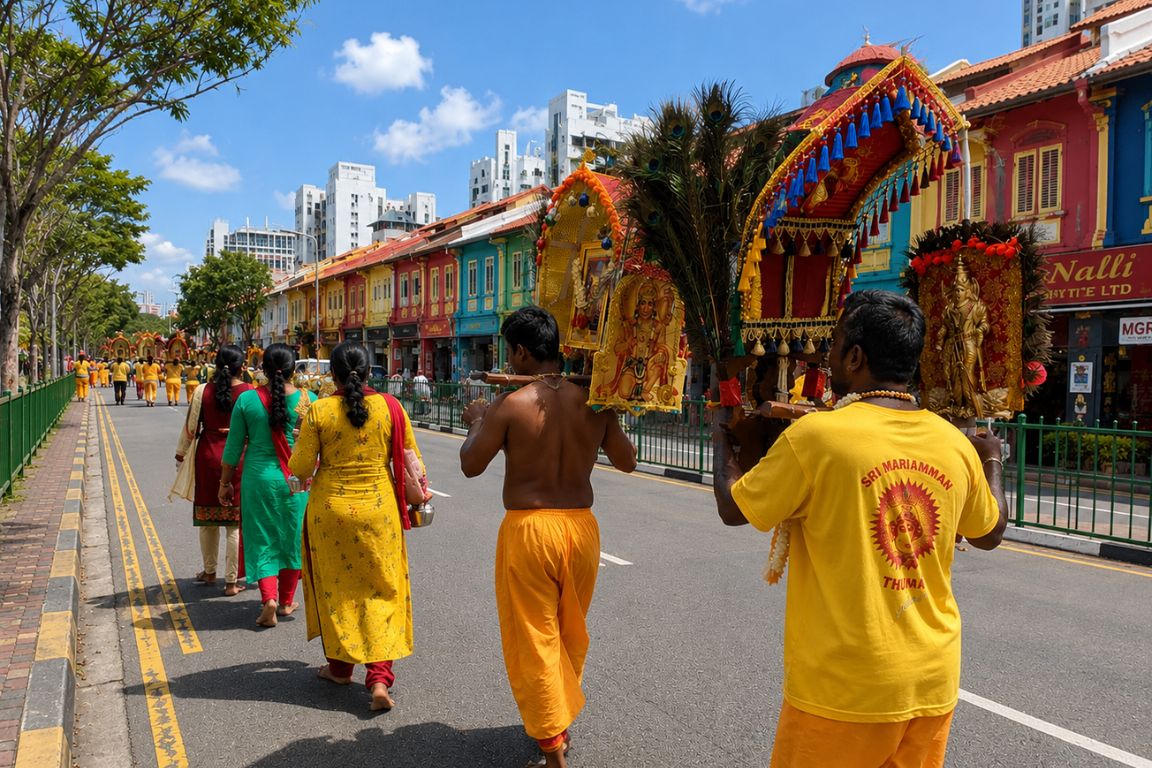 During Thaipusam, the staircase transforms into a continuous stream of devotees climbing in an act of religious penance and offering. The main day in 2026 is February 1st, when over 3.5 million visitors are expected at the site. Devotees climb barefoot, many carrying kavadis – some simple milk pots, others elaborate metal structures supported by skewers pierced through the skin. The stairs are no longer a tourist staircase. They become the central act of one of Southeast Asia’s largest religious gatherings.
To understand what the staircase becomes during Thaipusam, it helps to understand what’s happening on each step. Devotees who carry vel kavadis have fasted and prayed for 48 days. Some have travelled hours or days to be here. They are not performing for tourists – they are fulfilling vows made to Lord Murugan, completing acts of penance or gratitude, often in trance states supported by drumming, chanting, and the support of family members climbing alongside them.
The kavadis themselves range from simple pots of milk carried on the head to structures weighing up to 30 kilograms, decorated with peacock feathers and flowers, attached to the devotee’s body through multiple skewers. The sight of a devotee carrying one of these up 272 steps, barefoot, in trance, with family chanting around them, is something that stays with visitors regardless of their own religious background.
Practical guidance for attending: arrive before 7:00 AM if you want to climb the stairs with any freedom of movement – after that, the crowd controls the pace. Wear yellow or orange to blend with the devotional colour of the festival. Dark colours, particularly black, are considered inauspicious and best avoided on this day. The KTM train is the only sensible transport option; roads near the site close from January 30th through February 3rd for 2026. Take the free extended service from KL Sentral.
Photography note: the staircase during Thaipusam is extraordinary to document, but approach with care. Ask before photographing individuals in deeply personal devotional moments. The festival is an act of faith, not a spectacle organised for tourism. Respectful curiosity is welcomed. Pointing a phone at someone at close range while they’re in trance is not.
Thaipusam at Batu Caves is unlike anything most visitors have experienced before and the logistics reflect that – our visiting Batu Caves tours during Thaipusam guide breaks down the crowd management, transport changes, and what to realistically expect on the day.
What Are The Safety Rules And Risks On The Batu Caves Staircase?
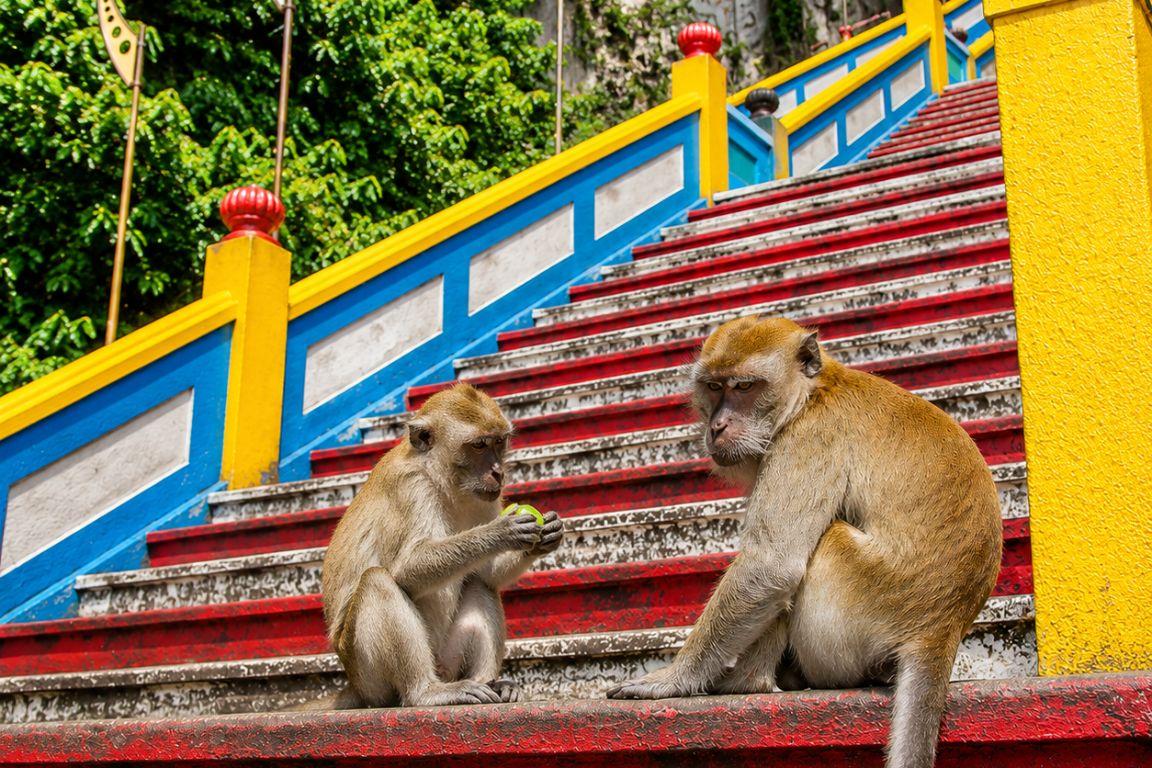 The main risks on the Batu Caves staircase are slipping on wet steps (highest risk on descent), heat exhaustion from midday climbing, and monkey encounters if food or open bags are present. There are no official rest stops, but wider landings exist every 50-60 steps. Temple security patrols the staircase and medical personnel are on standby during peak hours. The staircase is open from 6:00 AM to 8:30 PM daily.
Slipping is the most consistent physical risk, and it happens almost always on the descent. The painted concrete holds moisture from rain, from the cave ceiling dripping above the upper steps, and from the sheer volume of wet shoes tracked in from inside. The angle going down is steeper than it feels going up. Use the railings. Move slowly. If you’re with children, hold their hands on the way down and let the flow of crowd set your pace rather than fighting past people.
Heat exhaustion is real and not only a problem for unfit visitors. Malaysia’s humidity regularly exceeds 80% in the Gombak area, and the open face of the limestone cliff offers no shade from around 8:30 AM onward. Symptoms to watch for: dizziness, nausea, stopping sweating despite the heat, confusion. If you feel any of these, move immediately to the shade at the base, sit down, and drink water. Temple security can assist. Medical personnel are stationed on-site during peak hours. Don’t push through it.
Want to make Batu Caves a proper family experience without the stress of navigating 272 steps with a reluctant toddler? Here’s our Batu Caves tours with kids guide so you approach it the right way.
Monkey safety on the staircase comes down to one practical rule: nothing visible, nothing accessible. Food sealed in a bag that’s closed and worn in front of you is fine. Food in a hand, a side pocket, or an open bag is not fine. The macaques on steps 80-200 are the most active – they see the most traffic and have learned exactly what tourists carry. They don’t warn you before moving. A water bottle disappears in under a second. If a monkey approaches you without food being visible, stand still, don’t make eye contact, don’t make sudden movements. It will lose interest. If it becomes aggressive, move sideways rather than running – running triggers pursuit.
Medical advice: visitors with heart conditions, recent surgery, or significant respiratory issues should consult a doctor before attempting the climb. The site is not suitable for visitors with mobility limitations – there is currently no elevator or escalator, though one was announced in 2024. Ground-level attractions at Batu Caves, including the Ramayana Cave and forecourt temples, are accessible without the staircase and are worthwhile destinations in their own right.
Worried about the monkeys at Batu Caves and whether they’re actually as aggressive as people warn? Check out our monkeys at Batu Caves tours guide before your visit so you know what you’re dealing with.
What Our Guided Groups Report: Staircase Observations 2025
| Observation | From Our Guided Groups (2025) |
|---|---|
| Arrived wearing inappropriate footwear (sandals, flip-flops) | 42% of travelers |
| Had a monkey interaction on the staircase specifically | 68% of travelers |
| Needed to stop 3+ times on ascent due to heat | 85% of travelers arriving after 10 AM |
| Stopped for the view on descent (step 180 area) | 92% when specifically guided to |
| Knew the Dark Cave entrance was at step 204 before visiting | 15% of travelers |
| Total travelers guided through Batu Caves since founding | 6,500+ (active since 2015) |
Frequently Asked Questions
How many steps are at Batu Caves?
There are 272 concrete steps leading from the base of Batu Caves to the Temple Cave entrance. The staircase gains approximately 100 metres in elevation. Inside the Temple Cave there are around 101 additional steps leading to an inner chamber, which are separate from the main public staircase.
How long does it take to climb the Batu Caves stairs?
Most adults complete the climb in 10–20 minutes at a moderate pace with short breaks. The descent takes roughly the same time. Total time on the staircase up and down is typically 30-45 minutes. In early morning with cooler temperatures and lighter crowds, the lower end of that range is achievable. In midday heat, allow 30 minutes or more.
Are the Batu Caves stairs difficult to climb?
The step count alone is manageable – equivalent to roughly a 20-storey building. The difficulty comes from Malaysia’s tropical heat and humidity, which can exceed 80%. Most reasonably fit adults handle it without serious difficulty. The descent on wet or damp steps is where most incidents occur, so footwear and care going down matters more than going up.
What is the best footwear for the Batu Caves stairs?
Closed shoes with rubber soles and a decent tread. The steps can be slippery when wet, and the cave floor at the top is uneven and damp. Flip-flops and strappy sandals are a risk, particularly on the descent. Sport sandals with back straps are a workable compromise. Heels of any kind are not appropriate.
When were the Batu Caves stairs painted rainbow colours?
The steps were painted in August 2018 by around 100 volunteers over two and a half days, using surplus paint left over from the temple’s kumbhabhishekam renovation. The rainbow pattern — in sections of red, orange, yellow, green, and blue – went viral globally within days. The steps are repainted each year before Thaipusam.
What happens at the Batu Caves stairs during Thaipusam?
Thaipusam 2026 falls on February 1st, when over 3.5 million visitors are expected. The staircase fills with a continuous stream of barefoot devotees carrying kavadis — ceremonial burdens, some involving body piercings – as acts of devotion to Lord Murugan. Arriving before 7:00 AM gives the best chance of climbing with some freedom of movement. The KTM train is the only practical transport option as roads around the site close from January 30th.
Choose Your Batu Caves Day
Private Batu Caves & KL Cultural Tour. A private vehicle connects Batu Caves, Thean Hou Temple and the National Mosque, with independent time at the stops. Have a date in mind? Check it before arranging the rest of your KL day.
4 hours. English-speaking driver/guide. KL city hotel pickup and return; airport and Port Klang pickup cost extra. Food is extra. Mosque interior unavailable on Fridays. The Temple Cave requires stairs; this is not an accessible or festival-specific tour.
Choose a date to see scheduled departures. Final availability and price are confirmed on Viator.
No verified tour fits those requirements. Adjust your choices, or keep the independent plan described above. A festival, accessible route or another endpoint needs a separately confirmed service.
Compare Options And Fit Your Plans
General recommendations until you choose. English driver guidance does not promise an escort on the staircase. Confirm the exact pickup, child arrangements and site time on the listing.
- Private Batu Caves & KL Cultural Tour: 4 hours. A private vehicle connects Batu Caves, Thean Hou Temple and the National Mosque, with independent time at the stops. English-speaking driver/guide. KL city hotel pickup and return; airport and Port Klang pickup cost extra. Food is extra. Mosque interior unavailable on Fridays. The Temple Cave requires stairs; this is not an accessible or festival-specific tour.
- Batu Caves, Ramayana & Kanching Falls: 5 hours. Combine the Temple Cave with the Ramayana Cave story scenes and a Kanching waterfall stop. Five hours. English-speaking driver-assisted tour. Ramayana and Kanching admission included. Pickup depends on option. Not suitable for pregnancy or mobility impairments; child eligibility must be confirmed on the listing. Food and personal expenses are extra.