Monkeys at Batu Caves
Batu Caves monkeys are clever, fast, and used to tourists. Here’s how to avoid problems, protect your belongings, and what to do if scratched or bitten.
The independent visit described here remains an option. A paid tour adds transport and a planned route.
Last updated: May 16, 2026
Batu Caves Monkeys: Quick Safety Reference
| Topic | Key Facts |
|---|---|
| Species | Long-tailed macaque (Macaca fascicularis) – grey-brown, medium-sized, long tail |
| Danger level | Low-moderate. Opportunistic, not predatory. Most incidents involve food-triggered snatching. |
| Where most active | Steps 80-200 of the staircase. Present throughout, but densest in the middle section. |
| What they target | Food, water bottles, plastic bags, sunglasses, phones, shiny items, open bags |
| Never do | Feed them, make direct eye contact when they approach, try to take items back by force |
| If approached | Stand still, avoid eye contact, don’t make sudden movements, move sideways rather than running |
| If bitten or scratched | Wash wound thoroughly for 15 minutes, seek medical care the same day – don’t wait |
| Rabies risk (Peninsular Malaysia) | After any monkey bite or scratch, wash the wound promptly with soap and running water for 15 minutes and seek urgent medical assessment. A clinician should assess rabies prevention, tetanus and wound treatment using current exposure information. |
| Quietest time | Before 8:00 AM – monkeys are less active before tourist crowds arrive |
What Kind Of Monkeys Live At Batu Caves?
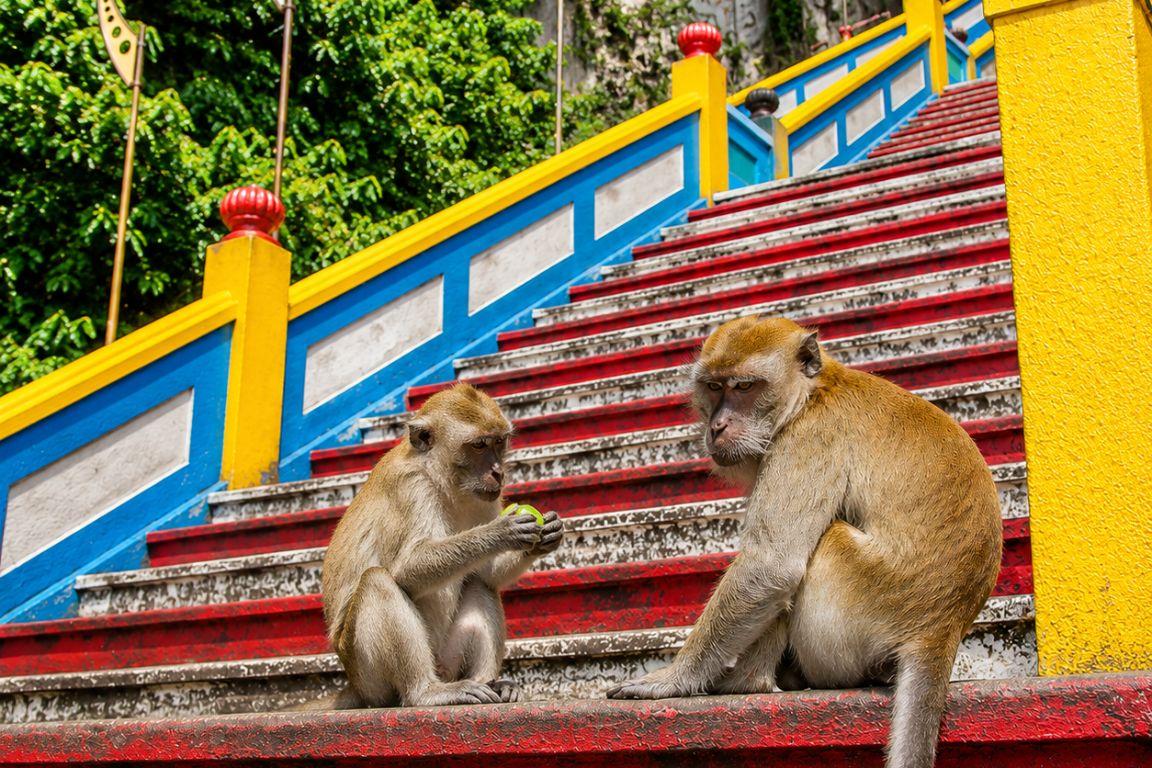 The monkeys at Batu Caves are long-tailed macaques, scientific name Macaca fascicularis. They are medium-sized primates native to Southeast Asia, grey-brown in colour, with distinctive long tails roughly equal to their body length. They are not aggressive by nature – they are opportunistic. The Batu Caves population has lived alongside humans for generations and learned, through direct experience, that tourists reliably carry food and are frequently not paying attention.
Long-tailed macaques are one of the most widespread primates in Southeast Asia and among the most studied. They live in groups called troops and have complex social hierarchies. At Batu Caves, the troop is large and well-established – multiple generations of macaques who have grown up watching humans arrive, stop to photograph the statue, reach into bags mid-staircase, and fail to notice what’s happening on the railing beside them.
They are listed as Endangered on the IUCN Red List as of their 2022 reassessment, a status that reflects declining habitat and overutilisation across Southeast Asia. The irony at Batu Caves is that the troop here is thriving precisely because of human provisioning – intentional feeding by vendors and visitors has sustained a population far larger and more behaviourally bold than a wild troop would be. Research on urban macaque populations in Malaysia consistently shows that access to human food correlates with larger group sizes, increased terrestrial behaviour (spending more time on the ground, closer to humans), and more aggressive interactions with tourists. The monkeys at Batu Caves are not a natural wildlife encounter. They are an urban-adapted population shaped by decades of human food availability.
Adult males are the largest animals in the troop and the most physically imposing – capable of moving very quickly and showing teeth as a threat display. Females with infants are worth specific attention: a mother macaque protecting an infant will defend it aggressively if she feels cornered or threatened. Juveniles are the most playful and the most likely to approach out of curiosity. None of these categories are dangerous if you understand what triggers their behaviour.
Are The Monkeys At Batu Caves Dangerous?
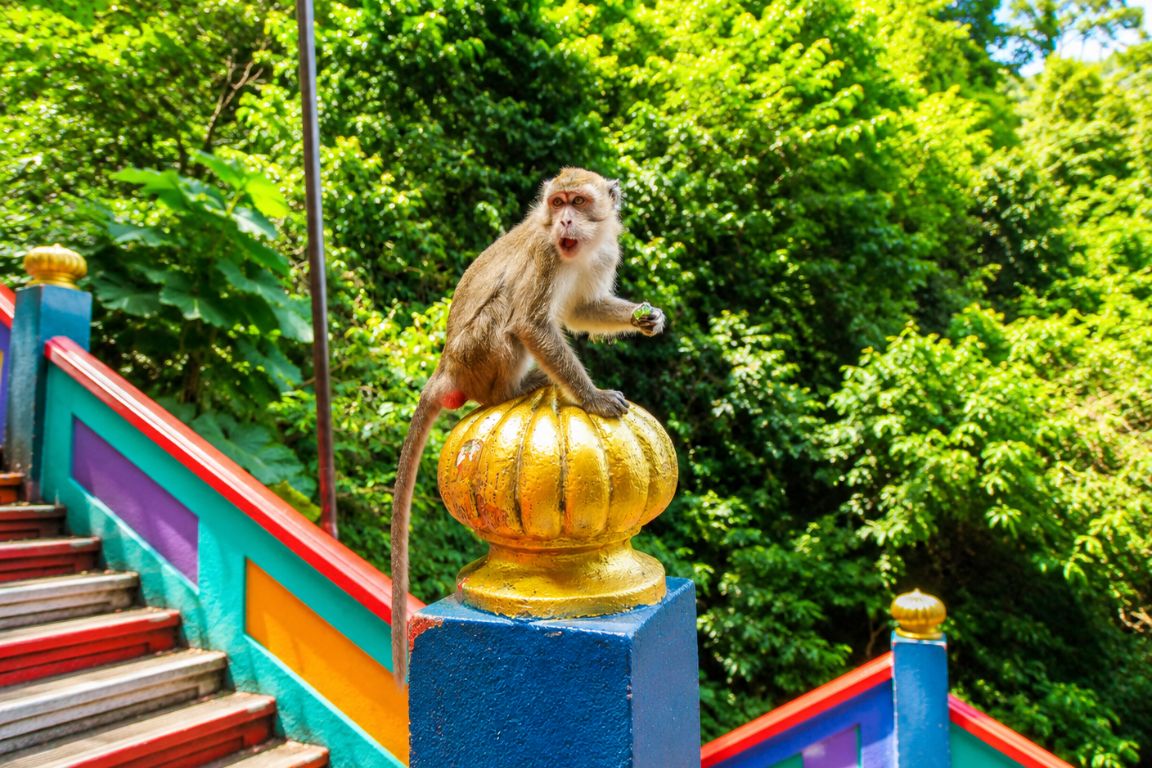 They are wild animals that bite and scratch, so yes – they carry a degree of real risk. But most encounters are opportunistic food-grabbing events, not unprovoked attacks. The macaques at Batu Caves are not predatory and have no interest in harming visitors who don’t have food. The risk rises sharply when tourists carry food openly, try to take grabbed items back, make threatening gestures, or feed the monkeys and then expect them to leave. Understanding what triggers them removes most of the danger.
Batu Caves is cited in international travel medicine literature alongside Bali’s Ubud Monkey Forest and Angkor Wat as a site where macaque-tourist incidents are documented and recurring. A 2014 European antirabies clinic study specifically named Batu Caves as one of the destinations where monkey bite injuries occur regularly. The incidents are not rare outliers – they happen to multiple visitors every week, more on busy days, and the patterns are consistent enough that temple security and medical personnel are stationed on-site during peak hours.
What the research on urban macaque populations across Malaysia shows is that tourist behaviour is the primary driver of aggressive incidents. A study on LTMs at a Malaysian urban tourism site found that 65% of human-macaque interactions in similar settings involved food or food cues. The monkeys have been conditioned over generations: tourist arrival means food is available. Open bags mean food is accessible. Someone pulling back on a grabbed item means there’s something worth fighting for. Remove those triggers and the risk drops dramatically.
Three-quarters of respondents in a study of visitor perceptions at Batu Caves reported being fearful of the macaques. That fear is reasonable, but it can produce the wrong responses – freezing, making sudden movements, or running – which are exactly the behaviours that escalate an encounter. The more useful frame is: these are wild animals responding predictably to stimuli. Understand the stimuli, and you largely control the outcome.
Where On The Staircase Are The Monkeys Most Active?
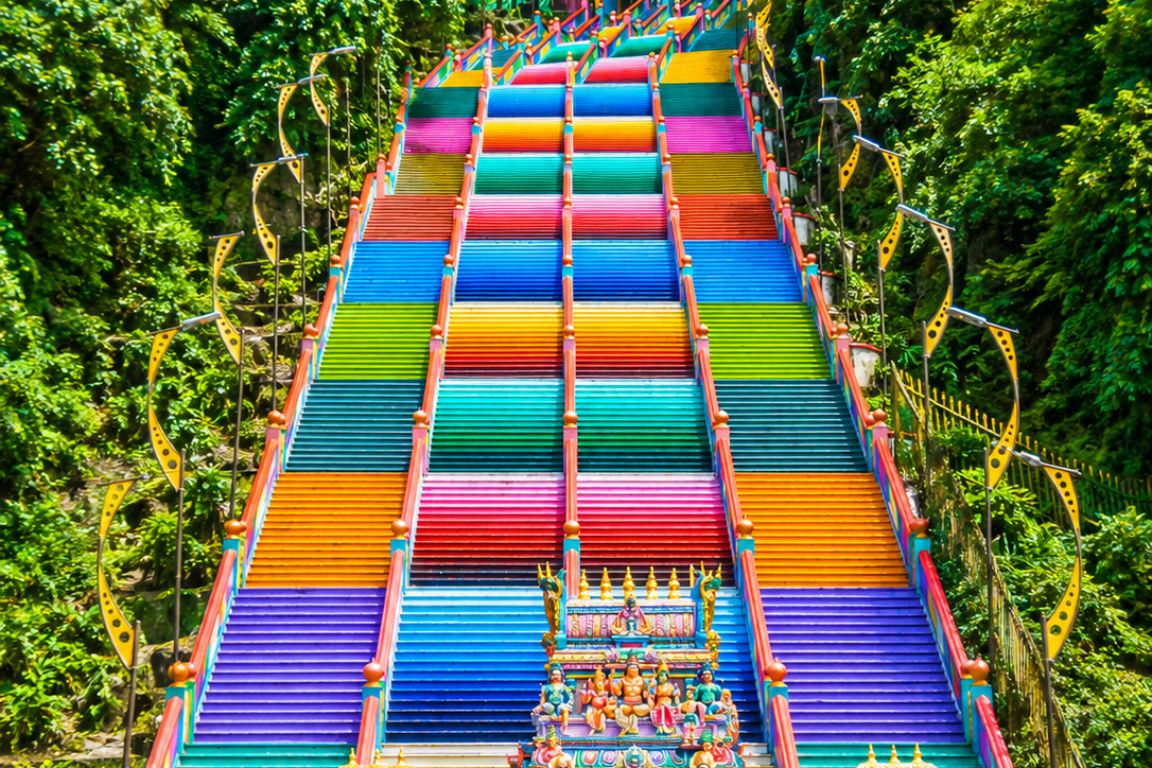 The macaques are present throughout the entire Batu Caves complex, but their activity concentrates in three distinct zones: the forecourt and lower staircase (steps 1-80), the middle section (steps 80-200), and the Temple Cave entrance and upper landing. The densest and most behaviourally bold concentration is the middle section, between roughly steps 100 and 200, where tourist traffic peaks and distraction is highest. The cave interior itself sees fewer monkeys than the staircase.
The forecourt and lower stairs (steps 1-80) are where the monkeys are most visible on arrival and where most visitors first notice them. The animals here tend to be calmer – there are people moving in all directions, security is visible, and the density of tourists provides them with many targets rather than a few concentrated ones. The behaviour here is mostly watching and occasional approach when something visible attracts attention. This zone is manageable with basic bag awareness.
Steps 80 to 200 are the zone that produces most incidents. By this point on the climb, visitors are tired, focused on the steps ahead rather than the railings, and often reaching into bags for water. The monkeys know this. They position themselves on railings at roughly human shoulder height – the same height as a water bottle in a side pocket or a phone in a hand. They move fast and without warning. This is also the stretch where other tourists have typically been feeding monkeys further down, which creates a more activated and food-seeking troop throughout the zone. Keep bags zipped and in front, nothing in external pockets, phones and cameras on straps, and move through this section at a steady pace without stopping mid-flight to rummage for anything.
The Dark Cave entrance area at step 204 has historically been a monkey concentration point – the gate creates a bottleneck where visitors slow down, and the monkeys have learned this. With the Dark Cave closed, the bottleneck effect is reduced, but the zone around steps 195-215 remains worth attention.
The Temple Cave interior itself is cooler and darker, and most of the macaques prefer the open staircase to the cave. Monkeys do enter the cave occasionally, particularly through the ceiling openings, but the interior is considerably less active than the stairs. It’s the one place on the visit where you can genuinely relax your monkey awareness for a few minutes.
Want to tackle the Batu Caves staircase without the rookie mistakes that slow most first-timers down? Here’s our Batu Caves stairs guide so you reach the top without regret.
Monkey Activity Zones On The Batu Caves Staircase
| Zone | Activity Level | What to Watch For |
|---|---|---|
| Forecourt and base of stairs (steps 1-80) | Moderate | Food vendors nearby attract monkeys; visible food is the main trigger |
| Middle staircase (steps 80-200) | Highest | Dense monkey presence on railings; bag openings, water bottles, and phones at risk |
| Dark Cave entrance area (around step 204) | High | Bottleneck zone where visitors slow; monkeys position at eye and shoulder level |
| Upper staircase and cave entrance (steps 200-272) | Moderate | Monkeys present but less concentrated; cave entrance offers some relief |
| Temple Cave interior | Low | Monkeys occasionally enter through ceiling openings but much less common than on stairs |
We’ve guided over 6,500 travelers through this staircase since 2015. If you want someone on-site who knows exactly where the monkey hotspots are on any given day, our team at Batu Caves Tours handles the logistics and the wildlife briefings together.
What Will The Monkeys Try To Steal At Batu Caves?
The primary targets are food and anything that resembles it: plastic bags, water bottles with visible liquid, snack wrappers, fruit, and drinks. Secondary targets are shiny or novel objects that attract curiosity: sunglasses, phones, cameras, keys, and jewellery. Soft bags with external pockets or open tops are at risk regardless of contents if the monkey has learned that bags contain foo which most of the Batu Caves troop has. An open handbag will be investigated within seconds of a monkey noticing it.
The food association runs deep. These macaques have been fed by vendors and tourists for decades. The smell of food inside a sealed bag is still a bag worth investigating. Several documented incidents involve monkeys grabbing entire bags – backpacks, tote bags, shopping bags – then taking them to a higher position and searching them methodically before discarding them. The monkey isn’t looking for your passport. It’s looking for food. If it doesn’t find any, the bag gets dropped. Which means your passport may survive, albeit from a height.
Water bottles deserve specific mention because they’re the item visitors most commonly assume is safe. A clear plastic bottle with liquid inside reads to a macaque as a potential food source. It won’t drink water enthusiastically, but it will investigate. More specifically, bottles in side pockets are at the exact height of a monkey sitting on a staircase railing as you pass. The bottle disappears before you’ve registered what happened.
Sunglasses on top of the head are a classic target. So are earrings, necklaces with pendants, and bracelets – particularly shiny ones. A neck cord for glasses costs almost nothing and prevents the single most common non-food theft at Batu Caves. Phones held in the hand while taking photos are at higher risk than phones in a zipped pocket. Cameras with neck straps are safer than cameras carried loosely.
Do not offer food to retrieve an item. Keep your distance and ask on-site staff for help rather than feeding or approaching a wild monkey.
How Do You Protect Your Belongings From The Batu Caves Monkeys?
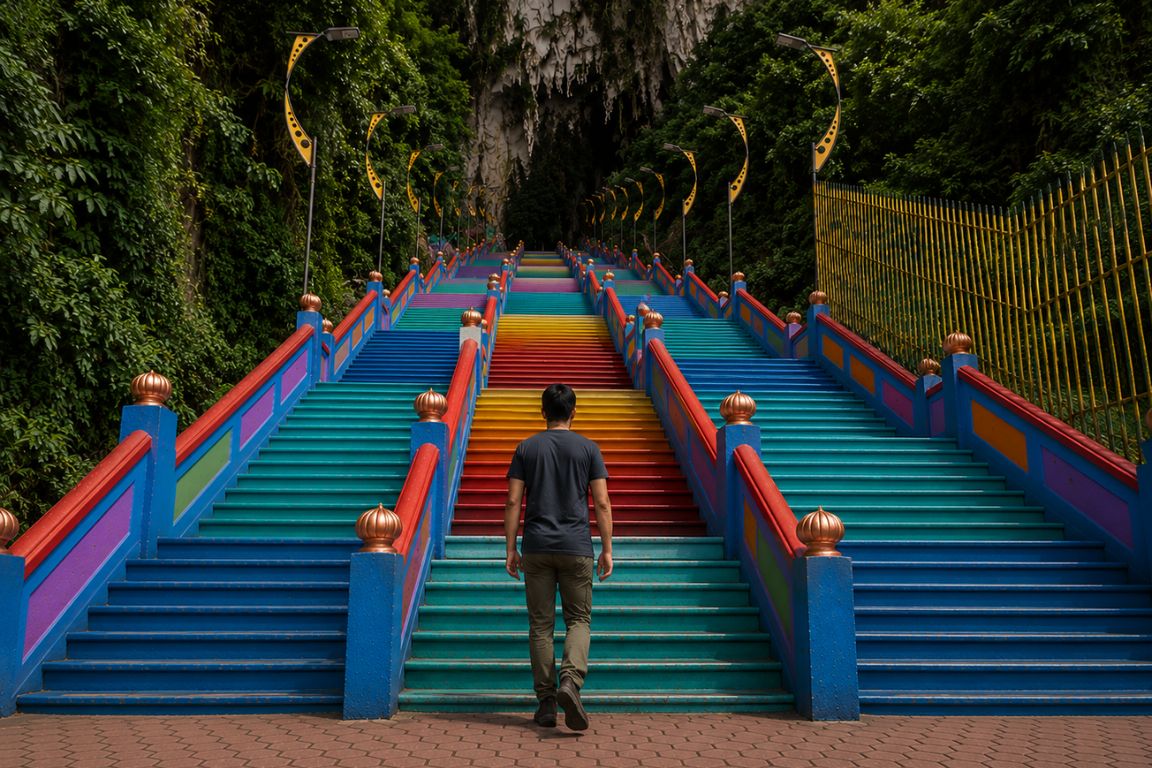 The protection strategy is simple: remove all triggers before you reach the staircase. Everything in a zipped bag worn in front of your body. No food visible or smellable. No water bottles in side pockets. Sunglasses on a cord. Phone in a pocket or on a wrist strap. Cameras on neck straps. The monkeys aren’t interested in attacking you – they’re interested in what you’re carrying. Remove the visible targets and the interaction risk drops close to zero.
The practical checklist before step one:
Eat and drink at the base before you start. Food consumed is food that can’t be grabbed. If you need water on the climb, drink from the bottle, cap it, and immediately return it to a zipped compartment inside your bag. A side pocket is not secure. If your bag doesn’t have zipped internal pockets, hold the bottle inside the bag rather than in a pocket.
Wear a cross-body bag or backpack in front of your body, zipped. A bag hanging behind you or to the side is accessible without you noticing. A bag in front means any monkey contact is immediately visible. This matters especially on the descent when you’re tired, moving more cautiously, and not watching your back.
Secure everything you’d be upset to lose. Glasses on a cord, phone on a wrist strap or in a pocket, cameras on neck straps. If you’re wearing jewellery, consider whether it’s worth the risk – visible pendants and large earrings are occasional targets.
Avoid plastic bags of any kind. They rustle like food packaging to a macaque’s ear, which is the sound that signals food. If you’re carrying a souvenir or item in a plastic bag, transfer it to a fabric bag before the staircase or put it inside a zipped compartment.
Do not feed the monkeys. This is worth stating plainly not just because it protects you but because it protects the next hundred visitors. Each feeding incident trains the troop that tourists are food sources and escalates the boldness of subsequent encounters. Vendors near the base of the stairs sometimes sell bananas specifically for tourist feeding. Buying and feeding is how the problem perpetuates.
Not sure what to wear to an active Hindu shrine that sees thousands of tourists every day? Here’s our Batu Caves tours dress code guide so you don’t get turned away at the entrance.
What Should You Do If A Monkey Approaches Or Grabs You?
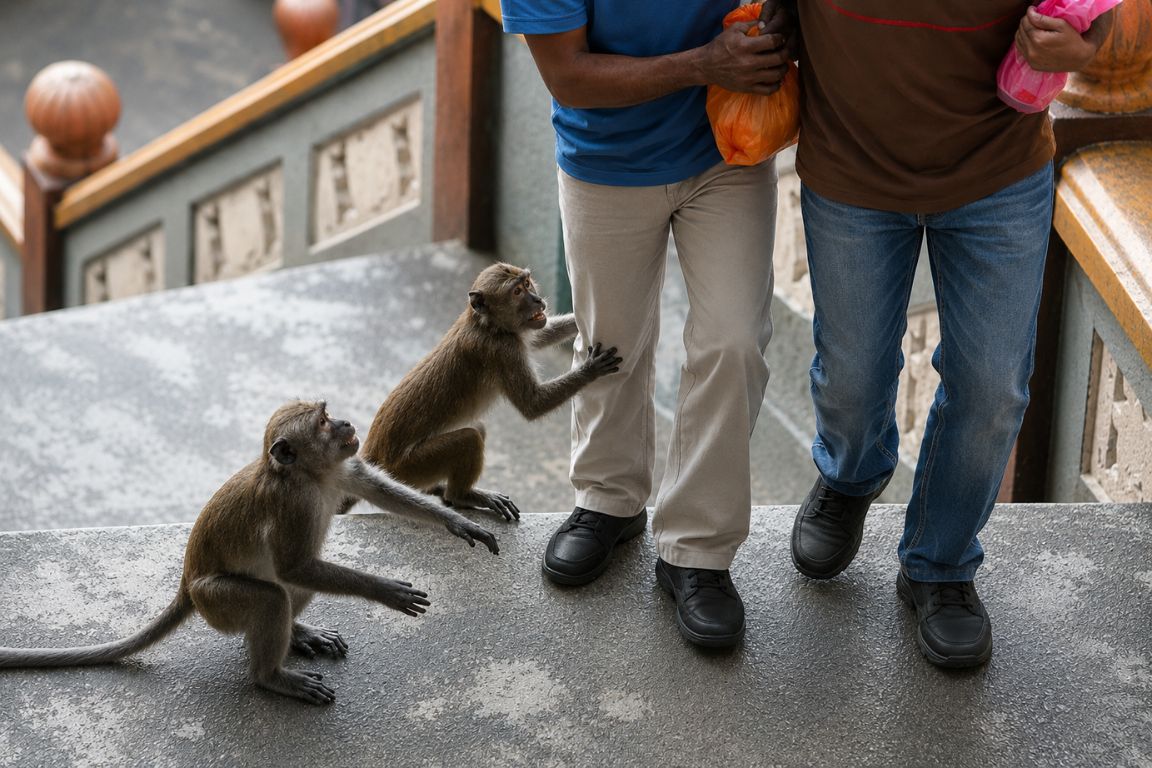 Stand still. Don’t make direct eye contact. Don’t make sudden movements or loud noises. If the monkey takes something, let it go. Do not try to grab items back by force, this is when bites happen. Move away sideways rather than running; running triggers pursuit in primates. If you want to discourage an approaching monkey without provoking it, look past it rather than at it, and move calmly away. The encounter ends when the monkey loses interest, which happens quickly if there’s nothing to gain.
The instinct when a monkey jumps at you is to pull back, make noise, or swipe at it. All three of these responses escalate the encounter. A macaque reading those signals reads them as threat or fight which produces defensive aggression. The non-threatening response feels counterintuitive but works: stop moving, drop the gaze, and wait. Most encounters resolve in under ten seconds if the human isn’t triggering a continued response.
Eye contact is a specific signal in primate communication that means challenge. A macaque that’s approaching opportunistically is doing so casually. Direct eye contact from a human reads as a counter-challenge and shifts the interaction from foraging to confrontation. Looking slightly to the side of the monkey – past it, not at it – removes that signal without requiring you to look away entirely.
If a monkey grabs your bag strap and pulls, your instinct is to pull back. Don’t. A macaque can sustain a significant tug-of-war and has better grip on the strap than you do. More importantly, the resistance signals that the bag is valuable, which increases the monkey’s motivation. If the strap is on your shoulder, take it off and let the monkey have the bag, they are looking for food, not valuables, and the bag will be dropped once searched. Your phone and wallet should be in pockets, not in the outer compartment of a bag that just got taken.
Temple security patrols the staircase and can intervene in persistent monkey encounters. If an animal is being unusually aggressive, moving toward the next security position and alerting staff is the appropriate response. They know the specific animals in the troop and know how to move them on.
What Should You Do If A Monkey Bites Or Scratches You?
After any monkey bite or scratch, wash the wound promptly with soap and running water for 15 minutes and seek urgent medical assessment. A clinician should assess rabies prevention, tetanus and wound treatment using current exposure information.
The 15-minute wash is not a suggestion, it is the WHO-recommended immediate response to any animal bite. Running water and soap physically remove viral and bacterial matter from the wound site. Most people wash for 30 seconds and consider it done. The correct duration is 15 minutes. Set a timer if it helps you hold to it. Don’t use alcohol or hydrogen peroxide as the first wash; they can damage tissue and slow healing. Soap and water first, antiseptic after.
After any monkey bite or scratch, wash the wound promptly with soap and running water for 15 minutes and seek urgent medical assessment. A clinician should assess rabies prevention, tetanus and wound treatment using current exposure information.
What you will likely need: tetanus assessment and update if your vaccination is not current. Antibiotic prescription for the bite wound, as monkey bites carry bacterial infection risk regardless of rabies status. Wound cleaning and dressing by a medical professional. In Kuala Lumpur, Gleneagles Hospital and Pantai Hospital both have emergency departments experienced with this type of presentation. Several Tripadvisor accounts from visitors bitten at Batu Caves describe presenting at Gleneagles and receiving prompt, professional care, typically leaving within an hour. Medical costs for a bite assessment and treatment in Malaysia are modest by international standards.
Wash the wound and seek medical care first. Record the time and location when practical; do not delay washing to take photographs.
We’ve put together a full transport breakdown in our how to get to Batu Caves from Kuala Lumpur guide so you know exactly how to get there, how long it takes, and what to expect at each stage of the journey.
What Do Most Visitors Get Wrong About The Batu Caves Monkeys?
The biggest misunderstanding is framing the monkeys as unpredictably aggressive animals. Most incidents follow a consistent pattern: visible food, open bag, or feeding triggers the encounter. Remove those triggers and the macaques at Batu Caves are largely indifferent to people moving past them. The second biggest mistake is trying to take grabbed items back by force, which is when bites happen. The third is feeding them – both directly and by accepting food offered by vendors. Every feeding incident makes the next visitor’s experience more dangerous.
Visitors who have bad experiences with the monkeys at Batu Caves almost universally describe being surprised. The monkey appeared from nowhere. There was no warning. It just grabbed the thing. This is accurate as a description of the speed of the encounter, but it misses what preceded it: the monkey had been watching for exactly that moment for some time before acting. They are patient and they are precise. The surprise is a reading failure, not an attack out of nowhere.
The other common misread is treating a curious approach as aggression. A macaque that walks toward you on the staircase railing is not necessarily planning an attack. It’s doing exactly what the research on provisioned urban macaques describes: investigating whether this human is carrying food, based on the cues it can read (bag shape, smell, whether you’re holding anything). If you have nothing and the bag is zipped, the investigation ends within seconds. If you have something visible and you react with panic or confrontation, the situation escalates. The monkey’s initial approach was opportunistic. Your response determined what followed.
Feeding deserves its own paragraph because it is the root cause of every other problem at this site. Every visitor who feeds a monkey – intentionally from a vendor banana or unintentionally by dropping food – reinforces a behavioural pattern that persists for years in the troop’s memory. The macaques at Batu Caves are bold because they have been fed at this site across multiple generations. Each feeding incident moves the threshold of acceptable human-proximity slightly closer. The downstream cost is borne by the next hundred visitors who arrive with nothing to give.
What most visitors also miss, in the other direction: the macaques are genuinely worth watching. A mother carrying an infant past your shoulder without a glance. Juveniles racing each other up the limestone wall beside the stairs at a speed that makes no physical sense. An adult male sitting on the railing at step 150 watching the city below with the posture of someone completely at home. These are wild animals living their lives in a place that happens to overlap with a busy temple complex. Seen without food visible and without anxiety, they are one of the more memorable parts of the visit.
We’ve been guiding visitors through this staircase since 2015 – alongside these same macaques, across seasons and festival days and quiet Tuesday mornings. Our team at Batu Caves Tours briefs every group before they start climbing, and the difference it makes is consistent. Informed visitors have far better experiences than uninformed ones.
What We See From Our Groups: Monkey Incident Data 2025
| Observation | From Our Guided Groups (2025) |
|---|---|
| Had a monkey approach or make contact | 64% of guided travelers |
| Had something grabbed or taken | 18% of guided travelers |
| Incident involved food or water (vs. non-food item) | 82% of all monkey incidents |
| Incident occurred in the steps 80-200 zone | 74% of all monkey incidents |
| Had arrived before 8 AM (lower incident group) | 88% of zero-incident groups |
| Total travelers guided through Batu Caves since founding | 6,500+ (active since 2015) |
Frequently Asked Questions
Are the monkeys at Batu Caves dangerous?
They can be if triggered, but most incidents are opportunistic food-grabbing events rather than unprovoked attacks. The macaques at Batu Caves are wild animals that bite and scratch, and any bite requires same-day medical attention. Understanding what triggers them – visible food, open bags, feeding – removes most of the risk.
What do the Batu Caves monkeys steal?
Food and anything that resembles it (plastic bags, water bottles, snack wrappers) are the primary targets. Sunglasses, phones, cameras, and jewellery are secondary targets. The most reliable protection is a zipped bag worn in front of the body with nothing in external pockets.
What should I do if a monkey grabs something at Batu Caves?
Let it go. Don’t try to take grabbed items back by force – this is when bites happen. The monkey is looking for food and will search the item and discard it quickly. Your valuables should be in internal pockets, not in an outer bag compartment that a monkey can take.
What should I do if I’m bitten by a monkey at Batu Caves?
After any monkey bite or scratch, wash the wound promptly with soap and running water for 15 minutes and seek urgent medical assessment. A clinician should assess rabies prevention, tetanus and wound treatment using current exposure information.
Where are the monkeys most active on the Batu Caves staircase?
The middle section of the staircase between roughly steps 80 and 200 has the densest monkey concentration and highest incident rate. This is where visitors are most tired, most likely to be reaching into bags, and where the monkeys have learned the greatest return on their attention. Early morning visits (before 8 AM) see lower activity across the whole staircase.
Is it safe to take photos of the monkeys at Batu Caves?
Yes, with care. Use a camera on a neck strap rather than held loosely. Keep a safe distance – two to three metres is sufficient for a decent photo and keeps you clear of any sudden approach. Don’t try to pose next to them or reach toward them. The juveniles especially are photogenic and will often ignore you entirely if you’re not carrying food.
Choose Your Batu Caves Day
Private Batu Caves & KL Cultural Tour. A private vehicle connects Batu Caves, Thean Hou Temple and the National Mosque, with independent time at the stops. Have a date in mind? Check it before arranging the rest of your KL day.
4 hours. English-speaking driver/guide. KL city hotel pickup and return; airport and Port Klang pickup cost extra. Food is extra. Mosque interior unavailable on Fridays. The Temple Cave requires stairs; this is not an accessible or festival-specific tour.
Choose a date to see scheduled departures. Final availability and price are confirmed on Viator.
No verified tour fits those requirements. Adjust your choices, or keep the independent plan described above. A festival, accessible route or another endpoint needs a separately confirmed service.
Compare Options And Fit Your Plans
General recommendations until you choose. English driver guidance does not promise an escort on the staircase. Confirm the exact pickup, child arrangements and site time on the listing.
- Private Batu Caves & KL Cultural Tour: 4 hours. A private vehicle connects Batu Caves, Thean Hou Temple and the National Mosque, with independent time at the stops. English-speaking driver/guide. KL city hotel pickup and return; airport and Port Klang pickup cost extra. Food is extra. Mosque interior unavailable on Fridays. The Temple Cave requires stairs; this is not an accessible or festival-specific tour.
- Batu Caves, Ramayana & Kanching Falls: 5 hours. Combine the Temple Cave with the Ramayana Cave story scenes and a Kanching waterfall stop. Five hours. English-speaking driver-assisted tour. Ramayana and Kanching admission included. Pickup depends on option. Not suitable for pregnancy or mobility impairments; child eligibility must be confirmed on the listing. Food and personal expenses are extra.