Batu Caves with Kids
Batu Caves is surprisingly family-friendly. Here’s how to handle the stairs with kids, avoid monkey problems, and why the Ramayana Cave is often the highlight for children.
The independent visit described here remains an option. A paid tour adds transport and a planned route.
Last updated: May 16, 2026
Batu Caves With Kids: Quick Family Reference
Tap a column heading to sort.
| Entry fee for kids | Free (Temple Cave). KTM train: children under 4 travel free; older children pay child fare (~50% of adult) |
| Stroller | Not suitable for the staircase. Can be left at shops near the staircase base for ~RM 5. Forecourt is stroller-navigable on flat ground. |
| Baby carrier | Strongly recommended for babies and toddlers. Back carrier preferred for the descent. |
| Minimum age (staircase) | No official limit. Babies in carriers welcome. Independent climbing typically manageable from age 5-6 with adult support. |
| Dress code for children | Lenient for young children; teenagers follow adult rules (shoulders and knees covered for the staircase) |
| Monkey risk for kids | Higher than for adults – children are at monkey height, more likely to carry food visibly, and react with movements that escalate encounters |
| Toilets | At train station (RM 0.30-0.50) and forecourt base. None at the top of the staircase. Use before climbing. |
| Best arrival time | Before 8:00 AM – cooler stairs, lower crowd, less active monkeys |
| Best cave for kids beyond the staircase | Ramayana Cave (RM 5) – colourful dioramas, cool temperature, no staircase required – Prices verified May 2026 |
Is Batu Caves Suitable For Kids?
 Yes. Batu Caves is one of the better family destinations in the KL area precisely because it works at multiple levels simultaneously: the giant golden statue and rainbow staircase delight children visually, the 272-step climb burns energy, the cave interior with its ceiling swallows and dripping rock is genuinely awe-inspiring, and the monkeys are fascinating wildlife when managed correctly. Children who visit tend to remember it. The main practical considerations are the staircase, the monkeys, and the heat – all manageable with the right preparation.
Over 6,500 travelers have come through Batu Caves with us since 2015. Families are a significant part of that group. The honest summary: we’ve seen toddlers carried up in carriers by parents who made it look easy, six-year-olds who climbed every step and announced it was the best thing of their lives, and twelve-year-olds who became genuinely absorbed by the Temple Cave shrines once someone explained what they were looking at. The age range that has a reliably good time here is wide.
The visit does ask something of children physically – 272 steps in tropical humidity is a real workout for small legs, and the descent on steep steps requires care and supervision. It asks something of parents logistically: no strollers on the staircase, no food in open hands anywhere near the monkey zones, sunscreen and water carried and managed, toilet stops planned before the climb rather than during it. None of this is beyond a prepared family. Most of it is solved by arriving before 8:00 AM and having read this article before you get on the train.
What Is The Age Limit Or Minimum Age For Batu Caves?
There is no official minimum age or age limit for Batu Caves. Babies in carriers are common on the staircase and completely welcome at the site. The Temple Cave has no age restriction. Young children and teenagers follow the same dress code as adults for the staircase and Temple Cave – shoulders and knees covered – though temple volunteers apply this less strictly to very young children. Teenagers follow adult rules without exception.
The question isn’t really about rules – it’s about physical readiness and parental judgement. Babies under 12 months are most comfortably managed in a carrier, front or back, with a parent taking the staircase at their own pace. Toddlers between 12 and 36 months are a mixed picture: some three-year-olds charge up 272 steps with more enthusiasm than their parents; others need to be carried for half of it. The decision is yours, based on what you know about your child’s stamina and temperament on physical days out.
Children from around age 5 or 6 generally manage the climb independently with adult supervision and a couple of rest stops. The main caveat is the descent, which has caught out many families who didn’t anticipate that tired legs, steep steps, and sometimes-wet painted concrete is a harder combination going down than going up. Hold hands on the descent. Set a steady pace. Don’t try to keep up with the flow if your child needs to take it slowly.
On the dress code for children: temple volunteers are generally lenient with young children in casual clothing at the staircase entrance. A toddler in shorts will not be turned back. A twelve-year-old in a miniskirt will be. The practical approach is to dress children modestly in the same spirit as you’re dressing yourself, it avoids any discussion at the entrance and models the respect the site deserves. The heat makes lightweight cotton trousers or a simple dress the sensible choice anyway.
On the KTM train, children under 4 travel free. Older children typically pay 50% of the adult fare. Cash or Touch ‘n Go both work.
Can Young Children Climb The Batu Caves Stairs?
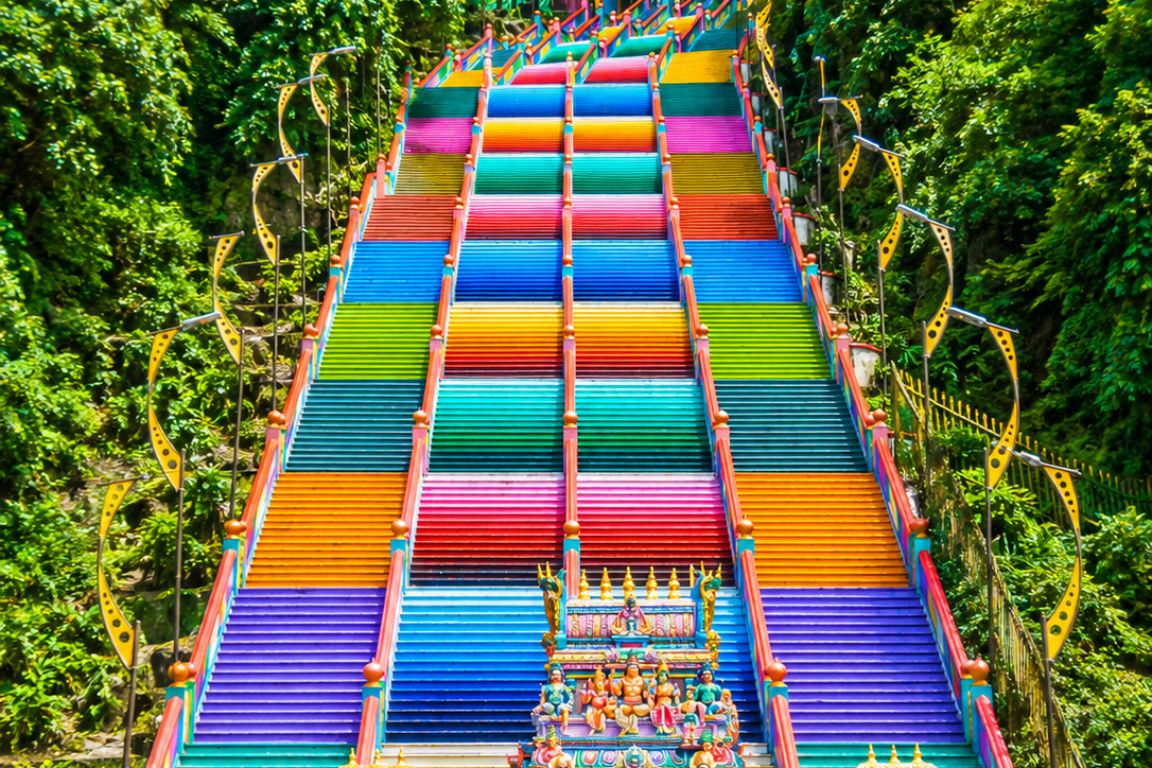 Yes, with the right approach for each age. Babies and toddlers go in a baby carrier – strollers cannot manage 272 steep steps and are impractical in the crowd. Children from about age 3 can attempt the climb but may need carrying for portions of it; a back carrier gives parents the option to rescue a flagging climber mid-staircase. Children from around age 5-6 typically complete the staircase independently. The descent needs more caution than the ascent: the steps are steep, can be wet, and small legs get tired. Hold hands going down and move at your child’s pace.
The staircase itself has a few features that parents need to know in advance. The steps are narrower than standard staircase treads – adult feet don’t always fit flat on the step, which means coming down requires awareness of foot placement. For small children with smaller feet, the width is actually more manageable, but their height relative to the railing means they can’t always grip it effectively. Holding an adult hand on the descent is not optional caution – it’s necessary.
The steps can be wet. This happens from two sources: rain (afternoon showers are common year-round, and the steps hold water), and water dripping from the limestone ceiling above the upper portion of the staircase, even in dry weather. Wet painted concrete is significantly more slippery than dry. Closed shoes with rubber soles are the minimum requirement for children. Sandals without back straps, and especially flip-flops, are a real risk on wet steps for short legs managing a steep descent.
For families with babies in carriers: the climb is physically demanding but absolutely doable. Multiple families complete it every day with infants. A structured back carrier with good hip support distributes the weight better than a front carrier for a long climb. Start early when the air is cooler. Take breaks at the natural landing points – there are wider rest areas every 50-60 steps where you can stop without blocking the flow. Water for both the carrier and the carried.
One practical point that saves significant trouble: there are no toilets at the top of the staircase or inside the Temple Cave. Use the toilet at the train station (RM 0.30-0.50) or at the forecourt base before starting the climb. A child who needs a toilet at step 150 creates a significant problem for the whole family. Experienced families with young children make the toilet stop non-negotiable before step one.
Not sure what 272 steps actually feels like in Malaysian heat and humidity before you commit to the climb? Here’s our Batu Caves stairs guide so you know exactly what you’re getting into.
Batu Caves Staircase: Age-by-Age Guide For Families
| Age Group | Staircase Approach | Key Considerations |
|---|---|---|
| Under 12 months | Carrier (front or back) | Back carrier preferred for balance and weight distribution; sun protection for baby on the open staircase |
| 12 months – 3 years | Carrier, or toddler walking with adult hand-holding (may need partial carrying) | Back carrier as backup even if toddler starts walking; have plan for carrying if they tire mid-staircase |
| 3-5 years | Walking with adult, rest stops every 50-60 steps, adult hand on descent | Variable – some 3-year-olds charge up enthusiastically; others flag at step 80. Know your child. Descent is the harder direction. |
| 5-10 years | Independent with adult nearby; hold hands on descent | Closed shoes with grip essential; brief them on the monkeys before the stairs; no food in hands |
| 10+ years | Independent; adult supervision on descent | Same as adults; dress code applies; watch for wet steps and monkey approach zones |
What Should Kids Wear To Batu Caves?
 Children need the same basic coverage as adults for the Temple Cave staircase: shoulders and knees covered. In practice, temple volunteers enforce this much more leniently on young children – a toddler in shorts is unlikely to be stopped. Teenagers are held to adult standards without exception. Beyond the dress code, the practical priorities for kids are closed shoes with grip (not sandals or flip-flops), lightweight breathable fabrics, and sun protection for the open staircase. Bring a lightweight scarf as a backup cover-up rather than relying on the sarong counter with a child in tow.
The dress code conversation for families usually comes down to teenagers rather than young children. A 13-year-old in shorts and a tank top will be turned back at the staircase entrance. A 3-year-old in shorts will almost certainly not. The middle ground – children aged 6-11 – varies by volunteer and by how close to the dress code the clothing is. The safest approach is simple: dress children modestly in the same spirit as you’re dressing yourself, and the entrance isn’t a conversation you’ll have.
Footwear is more important for children than adults. Small feet on steep, sometimes-wet painted concrete going down 272 steps is the highest-risk element of the visit for young children. Closed rubber-soled shoes or sport sandals with back straps. Not flip-flops. Not dress shoes. Not bare feet, regardless of what some devotees do during festivals – that is devotional practice, not a general visitor recommendation.
Sun protection deserves its own note. The staircase is fully exposed from about step 30 upward, and there is no shade from approximately 8:30 AM until you reach the cave entrance at the top. For fair-skinned children or those sensitive to heat, a hat and sunscreen applied before you leave the hotel is worth taking seriously. The climb takes 15-30 minutes in the sun for a young family, and children don’t always self-regulate sun exposure the way adults do.
Insect repellent is a practical addition for families with young children. The cave complex, and particularly the limestone cliff areas and the cave interior, harbours mosquitoes. A child-safe repellent applied before the visit avoids bites that tend to bother children more than adults.
Not sure what to wear to an active Hindu shrine that sees thousands of tourists every day? Here’s our Batu Caves tours dress code guide so you don’t get turned away at the entrance.
How Do You Keep Kids Safe Around The Monkeys?
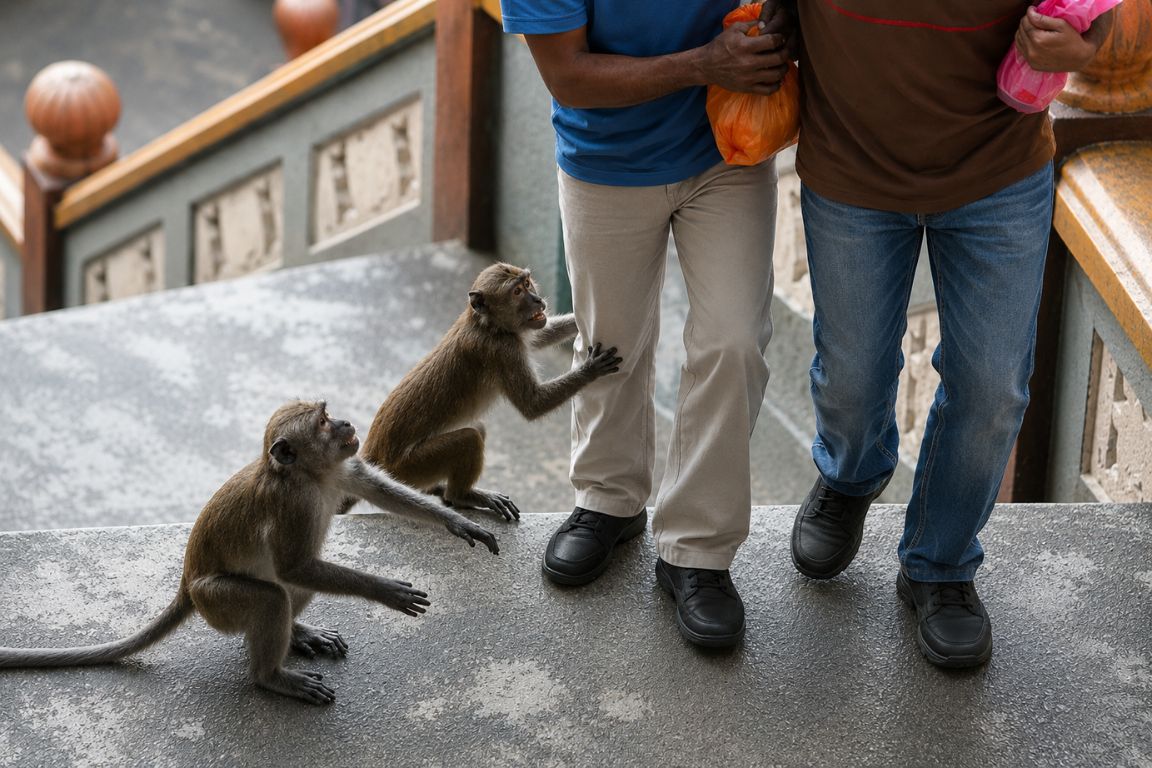 Children face a higher monkey risk than adults for three specific reasons: they are at monkey height on the staircase, they are more likely to carry food or drinks visibly or in loose hands, and they respond to sudden monkey movement with exactly the reactions – running, screaming, sudden gestures – that escalate encounters. Brief children on the monkeys before you leave the train, not after you see the first one. No food in hands on the staircase. Zipped bags, carried in front. If a monkey approaches a child, still hands, no eye contact, no running.
The height issue is the one parents consistently underestimate until they’re on the staircase. An adult standing on the steps has their bag at shoulder level. A young child on the same steps has their snack, drink, or toy at exactly the height of a macaque sitting on the railing. The monkey doesn’t need to jump at anyone, it can simply reach sideways. Children who are eating a biscuit or holding a drink bottle mid-staircase are handing a provocation directly to an animal that has refined its technique across millions of tourist visits.
The briefing before the staircase is genuinely important. Children respond differently to wildlife depending on what expectations they bring to the encounter. A child who arrives knowing these are wild animals that move fast and will take food, and who has been told specifically what to do if one approaches (be still, don’t scream, look away, don’t run) – behaves differently from a child who sees a monkey and reacts with excited shrieking and sudden movement. Both the animal and the child do better with the pre-briefing.
Practical rules for children on the staircase: everything edible goes into a zipped bag before step one. Water bottles go inside the bag, not in side pockets. Snacks eaten at the base before the climb, not on the way up. Phones and small toys in pockets or bags. If your child has a favourite stuffed animal or toy they’re carrying, it goes in the bag – shiny or novel objects attract monkey attention independently of food smell.
If a monkey approaches a child despite precautions: the adult places themselves between the monkey and the child, stays calm, avoids direct eye contact with the animal, and moves the child sideways rather than backward or in retreat. Running is the specific response that triggers pursuit. A calm sideways movement usually ends the encounter in a few seconds. Temple security patrols the staircase and can move persistent animals on – flag them if an encounter is escalating rather than trying to manage it alone.
After any monkey bite or scratch, wash the wound promptly with soap and running water for 15 minutes and seek urgent medical assessment. A clinician should assess rabies prevention, tetanus and wound treatment using current exposure information.
We’ve put together a full monkey encounter breakdown in our monkeys at Batu Caves tours guide so you know exactly what to expect, what to keep secure, and how to enjoy the site without an unwanted interaction.
What Can Kids See And Do At Batu Caves Beyond The Staircase?
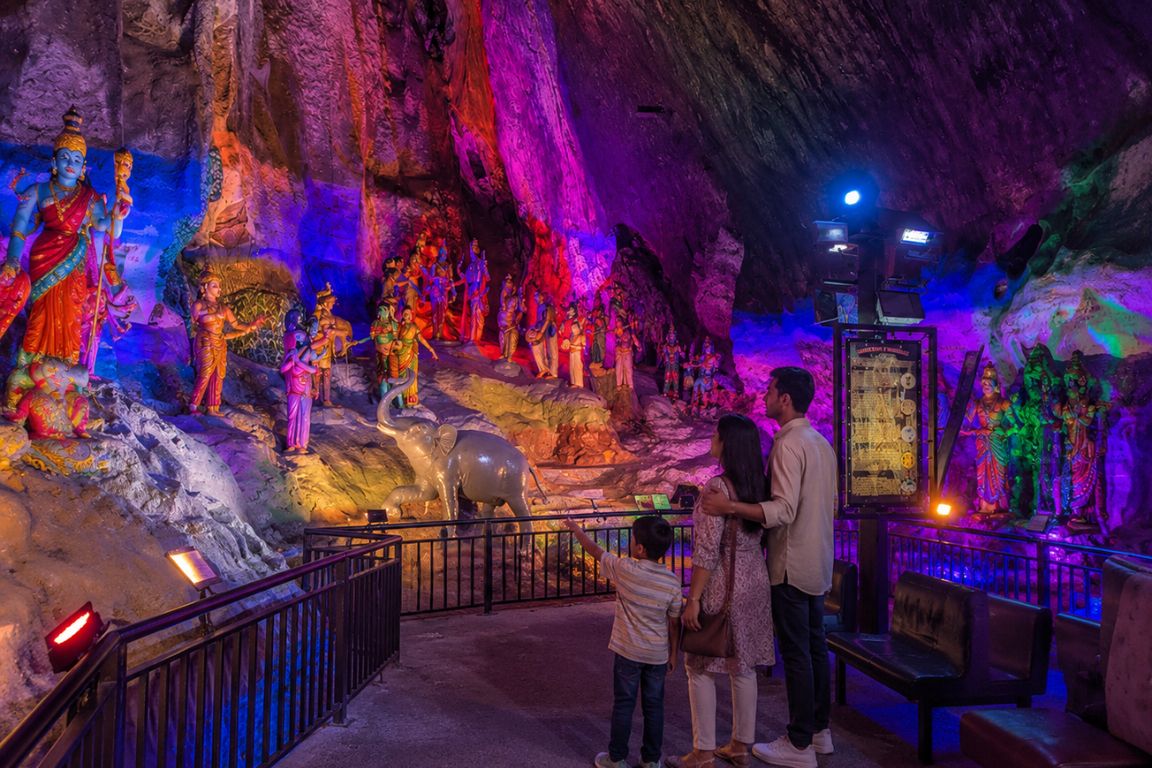
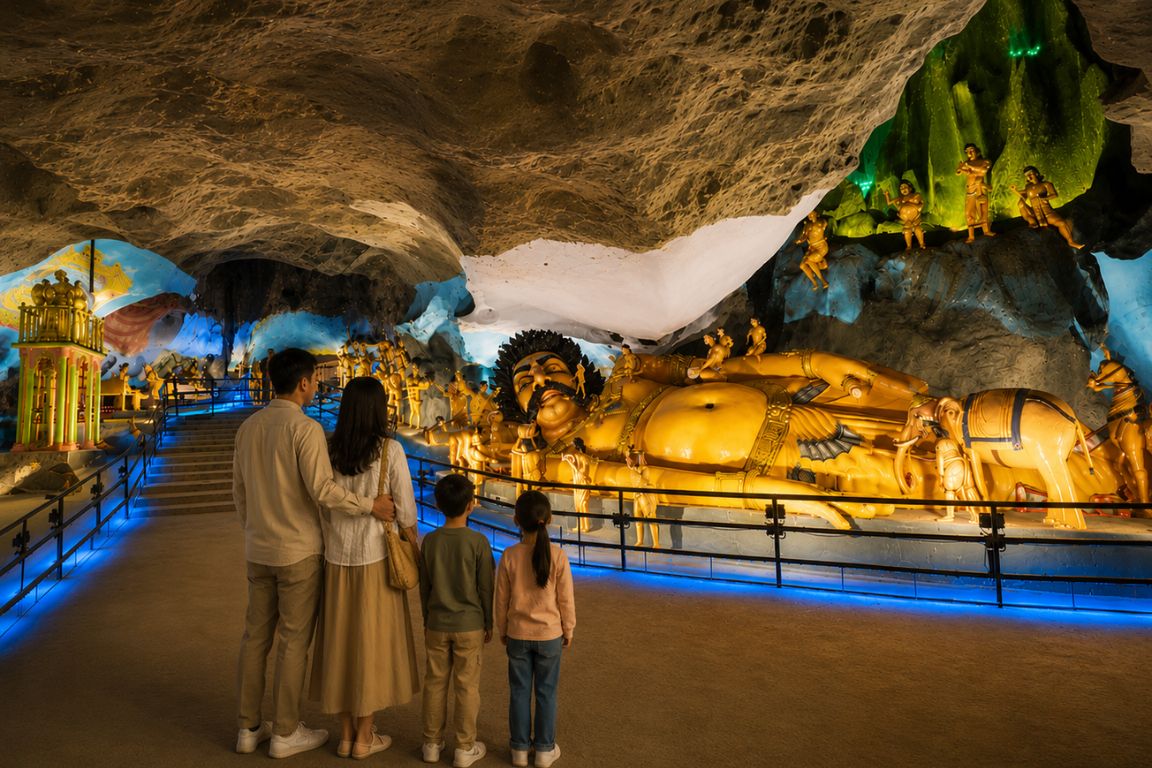
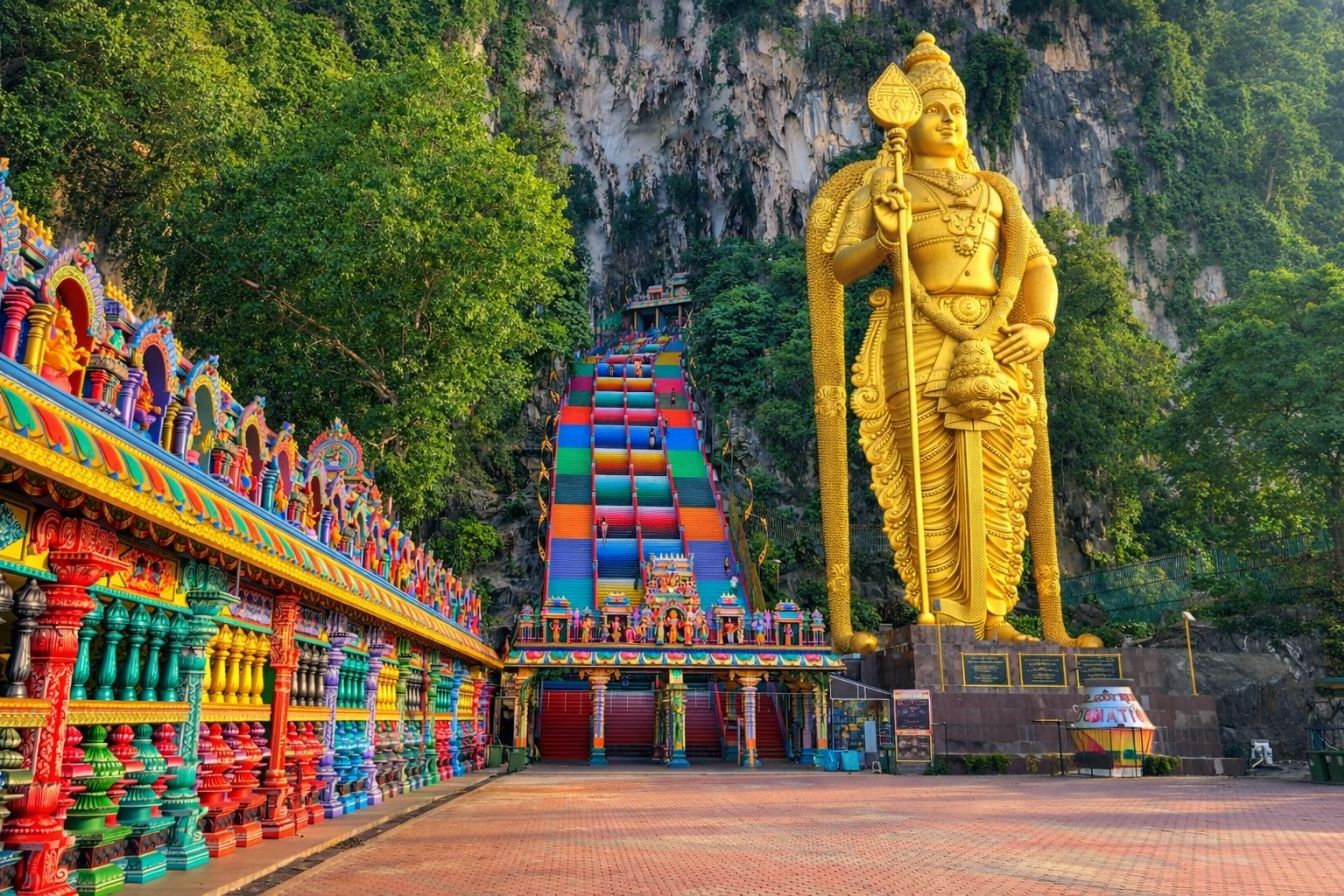 The Ramayana Cave (RM 5, ground level) is the best single child-friendly activity beyond the staircase. Its illuminated dioramas tell a dramatic story with giant colourful statues – the visual language is immediate and accessible for children with no background knowledge. The cave is cool, quiet compared to the main staircase, and takes 20-30 minutes. The forecourt area with its ornate temple buildings, the towering Lord Murugan statue, and the monkeys observed safely from a distance all create a visit that works even without the staircase climb.
The Ramayana Cave is consistently the surprise favourite for families. Adults often walk in expecting a mildly interesting tourist cave and walk out having spent considerably longer than planned. For children, the effect is more immediate: the entrance is guarded by a 15-metre green Hanuman statue, the cave interior is LED-lit in vivid colour, and the dioramas depict the Ramayana epic in a form that reads as action storytelling – demons, battles, flying monkeys, a princess in exile, a hero and his army. Children who are drawn to mythology and adventure will find more than they expect. The RM 5 entry is some of the best value in the complex.
The forecourt area below the staircase is more engaging for young children than most travel guides suggest. The ornate temple facades along the forecourt have carved and painted surfaces covering every centimetre – gods, demons, celestial animals, battle scenes from Hindu mythology – at child eye-level as well as above. Morning puja rituals happen at the small ground-level shrines from around 7:00 AM, and the sound of bells, chanting, and incense is genuinely captivating for curious children if approached respectfully and explained.
The monkeys themselves, watched from a safe distance with food secured, are one of the most memorable wildlife encounters children have in Malaysia. A mother carrying an infant. Juveniles chasing each other at improbable speed along the staircase railing. An adult male sitting with complete ownership of whatever surface he’s chosen to occupy. Watching them from a bench in the forecourt with nothing in hand is a genuinely enjoyable 15-20 minutes that costs nothing and creates memories families reference for years.
There’s more to Batu Caves than the staircase and the main cave most visitors stop at – our what to see at Batu Caves tours guide breaks down the art cave, the dark cave, and the temple complex most tourists walk straight past.
What Facilities Are Available For Families At Batu Caves?
 The facilities at Batu Caves are basic but functional. Public toilets are at the train station (RM 0.30-0.50) and in the commercial area at the base of the complex – none at the top of the staircase or inside the Temple Cave. There is no dedicated baby changing room. Strollers cannot manage the staircase and are best left with commercial vendors near the base for around RM 5. There are food stalls selling vegetarian meals and snacks. No nursing rooms exist but breastfeeding in the shaded forecourt area is common and accepted.
The toilet situation is the single most important facility planning point for families with young children. There are genuinely no toilets at the top of the 272 steps or inside the Temple Cave. The toilets at the train station exit, to the left as you leave the platform, are the cleanest option and worth using before you even start walking toward the cave complex. The forecourt toilets exist but receive heavier use and vary in condition. Neither provides toilet paper – bring tissues or a small roll in the family bag.
Stroller storage: vendors and shops at the base of the staircase, immediately before the steps begin, will typically hold a stroller for around RM 5 while you climb. This is an informal arrangement rather than an official facility, but it’s consistent and reliable. Leave the stroller, pay the fee, and collect it on the way back down. Don’t leave valuables inside it.
There is no air-conditioning anywhere in the public areas of the Batu Caves complex. The Temple Cave itself is cooler than the staircase and the forecourt because it’s inside limestone with limited sun exposure, but it is not air-conditioned. Plan for heat and humidity for the entire visit. Cold coconut water from the vendors at the base is excellent and not expensive – buy it at the start, drink it at the end.
Food for children: all vendors at Batu Caves serve vegetarian food. This is a Hindu temple site, and no meat is sold or prepared within the complex. Standard options include roti canai, banana leaf rice, mango lassi, coconut water, fresh fruit, and various fried snacks. Most children find something they’ll eat, and the food quality is genuinely good. All transactions are cash only.
What Are The Best Tips For Visiting Batu Caves With Kids?
The five most valuable tips for families: arrive before 8:00 AM, brief children on the monkeys before the train doors open, use the toilet at the station before starting the climb, carry everything in a zipped bag with nothing edible visible, and add the Ramayana Cave to the itinerary for RM 5 per person, it’s quieter, cooler, and often the best part of the day for children. Early timing solves heat, crowd, and monkey activity simultaneously. Everything else is detail.
Timing is the single highest-leverage decision for a family visit. Before 8:00 AM the staircase is shaded on its lower half, the air is ten degrees cooler in practice, the crowd is manageable, and the monkeys are noticeably less active. By 9:30 AM the tour buses have arrived, the full sun is on the steps, and every variable that makes a family visit difficult has doubled. The KTM train from KL Sentral leaves around 7:05 AM on weekdays. Taking it means arriving at 7:35 AM and having the site largely to yourselves for the first climb. This is the version of Batu Caves that families who have been before consistently choose when they return.
The monkey briefing should happen on the train, before the station doors open. Not at the base of the stairs when the first monkey is already visible and the briefing competes with excitement. On the train: these are wild animals, they are fast, they take food, here is exactly what we do if one comes close (be still, no screaming, no running, look away). Children who have had this conversation handle encounters calmly. Children who haven’t are unpredictable in the ways that most concern the animal.
The toilet stop at the station is non-negotiable for children under eight. The climb takes 15-30 minutes for a family, and there is no toilet option for the entire duration of the ascent and descent. For a child who announces a need mid-staircase, the options are: descend 150 steps, use a toilet, and re-climb all 272 again, or manage a situation on an active temple staircase surrounded by other visitors and wildlife. The two-minute toilet stop at the station prevents this scenario entirely.
The Ramayana Cave deserves advance planning rather than last-minute consideration. It opens at 9:00 AM, if your family arrives early and finishes the staircase by 8:30 AM, you’ll be waiting briefly. The sequencing that works best: arrive at 7:30 AM, do the forecourt and staircase, come down, have coconut water and a snack, and then visit the Ramayana Cave as it opens at 9:00 AM. The cave is almost always quiet at opening time, the lighting is dramatic, and children who have just climbed 272 steps in the heat find the cool, colourful interior a genuine reward. Budget 30-40 minutes and let children lead the pace through the dioramas.
First time visiting Batu Caves and not sure how to fit it into a Kuala Lumpur itinerary without it taking up more of the day than it should? Here’s our how to visit Batu Caves tours guide so you plan it efficiently.
What We See From Family Groups: 2025 Data
| Observation | From Our Guided Family Groups (2025) |
|---|---|
| Families with children under 5 who completed the staircase climb | 72% (most using carriers for at least part of the climb) |
| Children who identified the Ramayana Cave as their personal highlight | 84% of children aged 5-12 in guided groups |
| Families who had a monkey incident involving a child specifically | 24% (most involved food visible in a child’s hand) |
| Families who needed a toilet stop mid-staircase (after not using the base toilet) | 18% of groups with children under 8 |
| Families who said the visit was better than expected with children | 92% of all family groups |
| Total travelers guided through Batu Caves since founding | 6,500+ (active since 2015) |
Frequently Asked Questions
Is Batu Caves good for kids?
Yes. The rainbow staircase, the giant golden statue, the monkeys, and the cave interior are all immediately engaging for children. The main considerations are the staircase (manageable from around age 5-6 independently, or by carrier for younger children), the monkeys (manageable with preparation), and the heat (solved by arriving before 8:00 AM).
Can toddlers visit Batu Caves?
Yes. Toddlers are carried in a baby carrier on the staircase – strollers cannot manage 272 steps. Multiple families complete the climb with toddlers in carriers every day. A back carrier distributes weight better than a front carrier for the climb. Leave the stroller with vendors at the base for around RM 5.
Is there a minimum age for Batu Caves?
No official minimum age exists. Babies are welcome in carriers. Young children are welcome at all ages. The temple applies the dress code more leniently to young children but teenagers follow adult rules (shoulders and knees covered for the staircase).
Are the monkeys dangerous for children at Batu Caves?
The risk is higher for children than adults because children are at monkey height on the staircase and more likely to carry food visibly. Brief children on monkey behaviour before you arrive, keep all food in zipped bags, and teach children to stay still and avoid eye contact if a monkey approaches. Bites do occur and require same-day medical attention.
What is the best cave to visit at Batu Caves with kids?
The Ramayana Cave at RM 5 per person is the best family option beyond the main Temple Cave. Its illuminated dioramas of the Hindu epic are immediately visually engaging for children, the cave is cool and quiet, and it requires no staircase climb. Opens at 9:00 AM daily. Prices verified May 2026.
Are there toilets at the top of the Batu Caves stairs?
No. There are no toilets at the top of the 272 steps or inside the Temple Cave. Use the toilets at the train station (RM 0.30-0.50) or at the forecourt base before starting the climb. This is especially important for families with young children – mid-staircase toilet needs have no good solution.
Choose Your Batu Caves Day
Private Batu Caves & KL Cultural Tour. A private vehicle connects Batu Caves, Thean Hou Temple and the National Mosque, with independent time at the stops. Have a date in mind? Check it before arranging the rest of your KL day.
4 hours. English-speaking driver/guide. KL city hotel pickup and return; airport and Port Klang pickup cost extra. Food is extra. Mosque interior unavailable on Fridays. The Temple Cave requires stairs; this is not an accessible or festival-specific tour.
Choose a date to see scheduled departures. Final availability and price are confirmed on Viator.
No verified tour fits those requirements. Adjust your choices, or keep the independent plan described above. A festival, accessible route or another endpoint needs a separately confirmed service.
Compare Options And Fit Your Plans
General recommendations until you choose. English driver guidance does not promise an escort on the staircase. Confirm the exact pickup, child arrangements and site time on the listing.
- Private Batu Caves & KL Cultural Tour: 4 hours. A private vehicle connects Batu Caves, Thean Hou Temple and the National Mosque, with independent time at the stops. English-speaking driver/guide. KL city hotel pickup and return; airport and Port Klang pickup cost extra. Food is extra. Mosque interior unavailable on Fridays. The Temple Cave requires stairs; this is not an accessible or festival-specific tour.
- Batu Caves, Ramayana & Kanching Falls: 5 hours. Combine the Temple Cave with the Ramayana Cave story scenes and a Kanching waterfall stop. Five hours. English-speaking driver-assisted tour. Ramayana and Kanching admission included. Pickup depends on option. Not suitable for pregnancy or mobility impairments; child eligibility must be confirmed on the listing. Food and personal expenses are extra.