Visiting Batu Caves During Thaipusam
Thaipusam 2026 at Batu Caves happens on February 1st and draws millions of visitors. Here’s how to experience the festival respectfully, avoid the chaos, and catch the main procession.
The schedule below describes 2026. A normal sightseeing tour is not a festival booking; no festival-specific affiliate match has been verified.
Last updated: May 16, 2026
Thaipusam 2026 At Batu Caves: Quick Reference
Tap a column heading to sort.
| Main Thaipusam Day 2026 | Sunday, February 1, 2026 |
| Festival Period | January 30 – February 2, 2026 (four days) |
| Silver Chariot Departure | January 30, 9:00 PM from Sri Maha Mariamman Temple, Chinatown KL |
| Silver Chariot Arrival at Batu Caves | January 31 (after ~8-hour procession on foot) |
| Expected Visitors | 3.5 million+ across the festival period |
| KTM Train | Free, 24-hour service January 31 – February 1; roads closed |
| Best Arrival Time (main day) | Before 6:00 AM for staircase access; 3:00-5:00 AM for the chariot arrival experience |
| Dress | Yellow or orange welcomed; shoulders and knees covered; avoid black |
| Entry Fee | Free – Prices verified May 2026 |
| Open To | All visitors – Hindu and non-Hindu alike. Respectful attendance warmly welcomed. |
What Is Thaipusam And Why Does It Happen At Batu Caves?
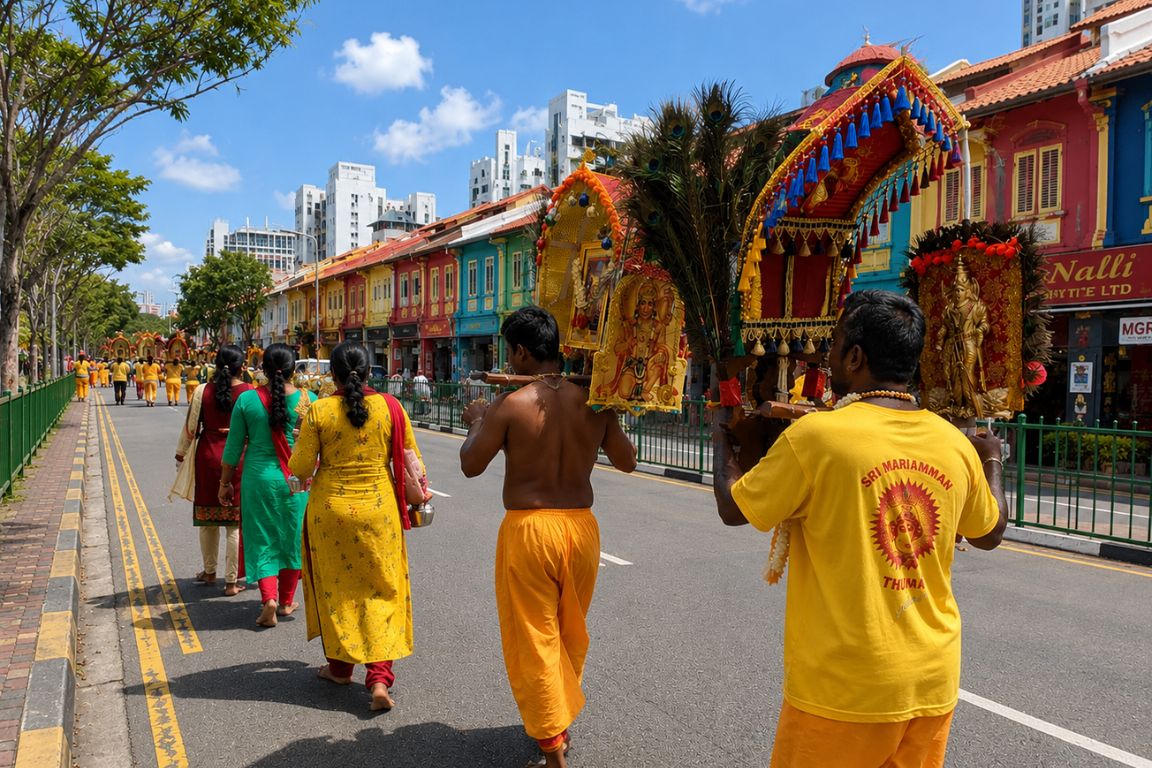 Thaipusam is a Tamil Hindu festival honouring Lord Murugan, celebrated on the first full moon of the Tamil month of Thai – typically January or February. It commemorates the day Murugan received a divine spear called the vel from his mother Parvati, which he used to defeat the demon Surapadman and restore order to the cosmos. At Batu Caves, devotees climb the 272 steps to reach the Lord Murugan shrine and fulfil vows made to the deity throughout the year. It is the largest Hindu gathering outside of India.
The connection between Batu Caves and Thaipusam was established in 1892 by K. Thamboosamy Pillay, the Tamil trader who built the first shrine inside the main cave. He noticed that the cave entrance was shaped like the vel – the divine spear of Lord Murugan, and chose this site to inaugurate the Thaipusam festival celebration in Malaysia. Over the century that followed, what began as a local Tamil community gathering became the largest Hindu festival in Southeast Asia, drawing millions across three days each year.
Thaipusam means something specific in the Tamil language. It joins the word “Thai” – the name of the tenth Tamil calendar month – with “Pusam,” a star whose position at its highest point during this month gives the festival its timing. The festival falls on the night when this star reaches its zenith, coinciding with the full moon. These were not arbitrary choices. Tamil astronomical and religious traditions are deeply interwoven, and the timing of Thaipusam places it at a moment considered maximally auspicious for approaching Lord Murugan.
For the Tamil community in Malaysia, Thaipusam is not simply a spectacle. It is the most important act of devotion in the religious calendar, the fulfilment of promises made in moments of crisis and gratitude, the continuity of a tradition carried across generations and across the Indian Ocean. For the millions of non-Tamil, non-Hindu visitors who attend each year – Malaysians of all backgrounds, international tourists, photographers, journalists – it is one of the most intense and visually extraordinary public events in the world. Both experiences are real and both are valid. They coexist in the same staircase, on the same February morning.
When Is Thaipusam 2026 At Batu Caves?
Thaipusam 2026 falls on Sunday, February 1st. The full festival period at Batu Caves runs from January 30th through February 2nd. The Silver Chariot procession departs Sri Maha Mariamman Temple in KL’s Chinatown at 9:00 PM on January 30th and arrives at Batu Caves on January 31st after an approximately 8-hour overnight journey on foot. The main day of kavadi climbing is February 1st. A return chariot procession heads back to Chinatown on February 2nd.
The four-day structure matters for planning. Each day of the festival period offers a different experience, and knowing the schedule lets you choose which part you want to witness.
January 29th is when a yellow rooster flag – symbolising Murugan’s army – is hoisted at the cave complex, marking the formal opening of the festival. The site shifts noticeably from ordinary temple activity to festival preparation. Vendors, stalls, and volunteer kitchens begin setting up around the forecourt.
January 30th evening is when the Silver Chariot procession begins at Sri Maha Mariamman Temple on Jalan Tun H.S. Lee in Chinatown. The chariot – a 5-tonne silver structure bearing statues of Lord Murugan, his consorts Theivana and Valli – departs at approximately 9:00 PM accompanied by hundreds of thousands of devotees chanting, drumming, and walking barefoot for 15 kilometres through KL’s streets toward Batu Caves. Watching this departure from Chinatown is a separate and powerful experience from the cave visit itself.
January 31st through February 1st is the core of the festival. The chariot arrives at Batu Caves, priests conduct the abhishekam (ritual bathing of deities) in the early morning, and then the kavadi procession begins in earnest. Devotees have been arriving through the night. By 5:00 AM on February 1st the staircase is already flowing with people.
February 2nd sees the chariot return to Sri Maha Mariamman Temple, the procession smaller but still significant, the mood more subdued and reflective after the intensity of the previous two days.
Thaipusam 2026 At Batu Caves: Day-by-Day Schedule
| Date | Key Events | Best For |
|---|---|---|
| Jan 29 | Yellow rooster flag hoisted at Batu Caves; festival preparations begin | Quieter approach; seeing the site before the full crowd |
| Jan 30 (eve) | Silver Chariot departs Sri Maha Mariamman Temple at 9 PM; overnight procession begins | Watching the chariot departure in Chinatown – a different, intimate experience |
| Jan 31 | Chariot arrives at Batu Caves at dawn; abhishekam (deity bathing ritual) from 4:30 AM | Arriving with the chariot procession; dawn atmosphere at the base |
| Feb 1 (main day) | Full kavadi procession from dawn; peak crowd; KTM free 24-hour service | The full Thaipusam experience – arrive before 6 AM for the staircase |
| Feb 2 | Chariot returns to Sri Maha Mariamman Temple; closing rituals | Seeing the return procession in a calmer atmosphere |
What Do You See At Batu Caves During Thaipusam?
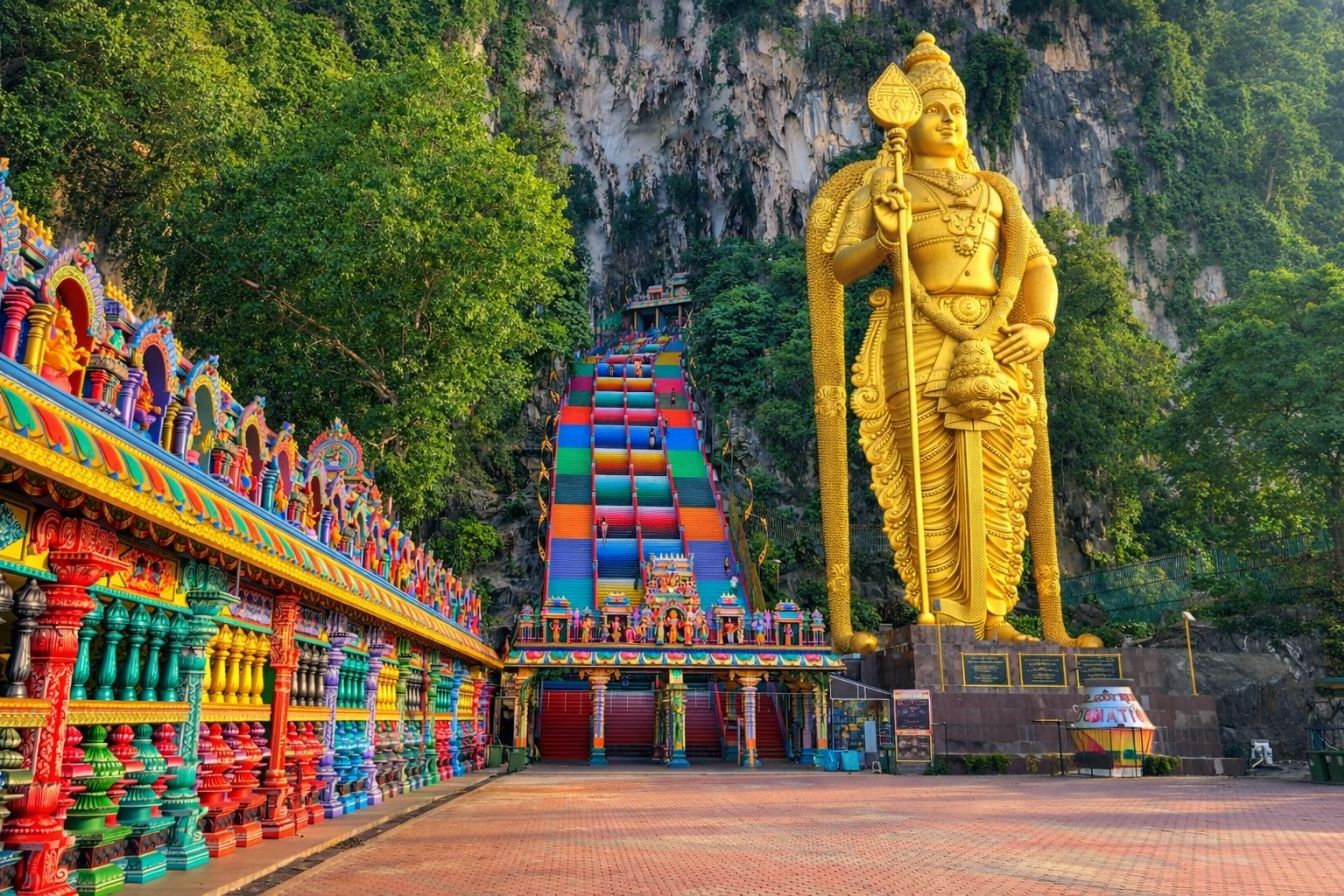 Thaipusam transforms every part of Batu Caves into something unrecognisable from its ordinary state. The forecourt becomes a festival ground with volunteer food stalls, vendor tents, and family camps. The staircase fills with a continuous stream of barefoot devotees in yellow and white, many carrying kavadis. The Temple Cave holds thousands simultaneously under chanting and drumming. The Lord Murugan statue is lit and garlanded. The scale is unlike anything a normal visit prepares you for.
The first thing that shifts is the sound. Thaipusam is not a quiet festival. The urumi melam drumming – a traditional Tamil percussion tradition – begins in the early morning hours and continues through the day, carried by accompanying musicians who walk alongside kavadi bearers. Chanting of “Vel vel shakti vel” – a devotional call to Murugan’s divine spear – rises and falls across the forecourt. By 5 AM on the main day, the combined sound of drums, chanting, and the movement of millions of people fills the entire complex in a way that is felt physically as much as heard.
The visual centrepiece is the kavadi procession. Devotees in saffron yellow and white ascend the rainbow staircase in an almost-unbroken stream from before dawn until late evening. Some carry simple milk pots (paal kudam) on their heads – these are the most common form of offering. Others carry elaborate vel kavadis: towering metal structures decorated with peacock feathers, flowers, and images of Lord Murugan, attached to the devotee’s body through skewers pierced through the skin of the chest and back. Many carry these kavadis with their cheeks and tongues pierced, unable to speak, moving through the crowd accompanied by family members chanting on either side.
At the base of the staircase, the preparations for piercing happen in small family circles with incense and prayer. Watching this – being welcomed to observe from a respectful distance – is one of the most profound things available to a non-Hindu visitor at Thaipusam. The priest or piercer moves with complete calm. The devotee enters a trance. Family members chant. The skin is pierced. No blood appears. The devotee rises, arranges their kavadi, and begins the climb.
Volunteer food stations line the approaches to the site, serving free meals to all comers regardless of religion. Coconuts are smashed in acts of offering throughout the day – the sound of coconut splitting on concrete is continuous and rhythmic. The smell of incense, camphor, and fresh marigold flowers is everywhere. The KTM station is running continuously with festival passengers. On the elevated MRR2 highway above the site, thousands of parked cars create an elevated viewing platform for photographers who arrived the night before.
Heading to Batu Caves and want to know what’s genuinely worth your attention beyond the climb? Here’s our what to see at Batu Caves tours guide so nothing important passes you by.
What Is A Kavadi And What Does Carrying One Mean?
Kavadi means “burden” in Tamil. It is a physical offering carried by a devotee to fulfil a vow made to Lord Murugan – a promise of penance or gratitude, typically made during a time of serious need. Kavadis range from a simple pot of milk balanced on the head to a metal structure weighing up to 30 kilograms, decorated with peacock feathers and attached to the devotee’s body through multiple piercings. The act of carrying a kavadi is not self-punishment. It is the completion of a debt of devotion.
To understand the kavadi, you need to understand the vow that precedes it. A devotee in crisis – facing illness, infertility, financial ruin, the illness of a child – prays to Lord Murugan and makes a promise: if this is resolved, I will carry a kavadi to your temple at Thaipusam. The kavadi is not the prayer. It is the fulfilment. The person climbing the 272 steps with a vel kavadi has already received the answer to their prayer. The climb is their act of gratitude and repayment.
Preparation for carrying a vel kavadi begins 48 days before Thaipusam. The devotee follows a strict vegetarian diet – primarily milk, fruit, and unprocessed food. Onions, garlic, and strong spices are forbidden. Alcohol, tobacco, and sexual activity are completely abstained from. The devotee sleeps on the floor rather than a bed, bathes daily in cold water, and fills their time with prayer, meditation, and charitable acts. The purpose is not performance. It is a genuine purification of the body and mind, preparing both for the trance state that allows the piercing to happen without pain or bleeding.
On the morning of Thaipusam, the devotee gathers with family and the kavadi piercer – often a family member who has performed this role for decades. Incense is burned, prayers are offered to Lord Murugan, and the devotee enters the trance state through chanting and deep meditative focus. The piercings – hooks through the chest and back to support the kavadi frame, skewers through the cheeks to silence speech and force the focus entirely inward – are then applied. Experienced piercers report that blood rarely appears at the piercing sites. The devotee who emerges from the piercing into the full kavadi is in a state of deep spiritual concentration, supported by family members walking alongside them, chanting “Vel vel Muruga.”
There are three levels of kavadi commitment. The simplest is the paal kudam – a pot of milk carried on the head, representing humility and offering. The middle form is the kavadi frame without piercing, decorated and balanced on the shoulders. The most advanced is the vel kavadi with full body piercing, which represents the ultimate surrender of the physical self to Lord Murugan. Most kavadi bearers at Batu Caves are at the first or second level. The vel kavadi bearers are fewer but impossible to miss – they are the ones who stop the crowd and remind every witness of what devotion at its deepest level looks and feels like.
At the end of the procession, inside the Temple Cave, the kavadi is brought before the Lord Murugan shrine. The milk offering is poured over the deity’s statue. Family members carefully dismantle the kavadi structure, remove the piercings, and apply sacred ash (vibhuti) to the wounds. Observers consistently report minimal bleeding even at this stage. The devotee emerges from the trance. Family celebrates. Many kavadi bearers return the following year, and the year after that, for decades.
How Do You Get To Batu Caves During Thaipusam?
 Take the KTM Komuter train. During Thaipusam 2026, KTM provided free 24-hour service from January 31st to February 1st, with 609 trips across the festival period – a 23% increase over normal service. All roads within several kilometres of Batu Caves are closed from January 30th through February 2nd. Grab and private taxis cannot reach the site during the festival. Driving to Batu Caves on the main day is not a viable option. The KTM is the only practical transport.
This is worth stating plainly because every year visitors attempt to drive or Grab to Batu Caves on the main day and find themselves stuck kilometres away with no option but to walk. The road closures are extensive and enforced. The only way in for a non-participant is the train. From KL Sentral, the journey takes roughly 30 minutes and costs nothing during the free service window. The train runs 24 hours, meaning a 3 AM arrival – which is optimal if you want to experience the chariot arrival and the pre-dawn atmosphere – is entirely achievable from any hotel in KL.
For visitors who want to experience the Silver Chariot departure on January 30th evening before heading to Batu Caves: go to Sri Maha Mariamman Temple on Jalan Tun H.S. Lee in Chinatown around 7:00-8:00 PM. The chariot departs at approximately 9:00 PM. Watch it leave from street level – the procession moving through KL’s Chinatown streets is spectacular in its own right, and considerably more intimate than the scene at Batu Caves. After the departure, take the LRT from Pasar Seni station to KL Sentral, then the KTM to Batu Caves to arrive before dawn.
Shuttle buses also operated during Thaipusam 2026, running free of charge from Pasar Seni City Hub, Gombak LRT station, and Kampung Batu MRT station every 10 minutes from 6 AM. If you’re staying near one of these points and prefer not to navigate KL Sentral, the shuttle is a valid alternative. Check the Rapid KL announcements closer to the festival date for confirmed 2027 routes and times.
On returning: the KTM runs continuously. There is no exit rush at a single time – the festival flows through the entire day and night, and visitors spread their departures accordingly. If you’re leaving mid-morning after the peak crowd, expect a wait of 15-30 minutes for a train with reasonable space.
Planning a trip to one of Malaysia’s most iconic Hindu shrines and not sure how to approach the visit? Here’s our how to visit Batu Caves tours guide so you plan it properly.
What Should You Wear And Bring To Thaipusam At Batu Caves?
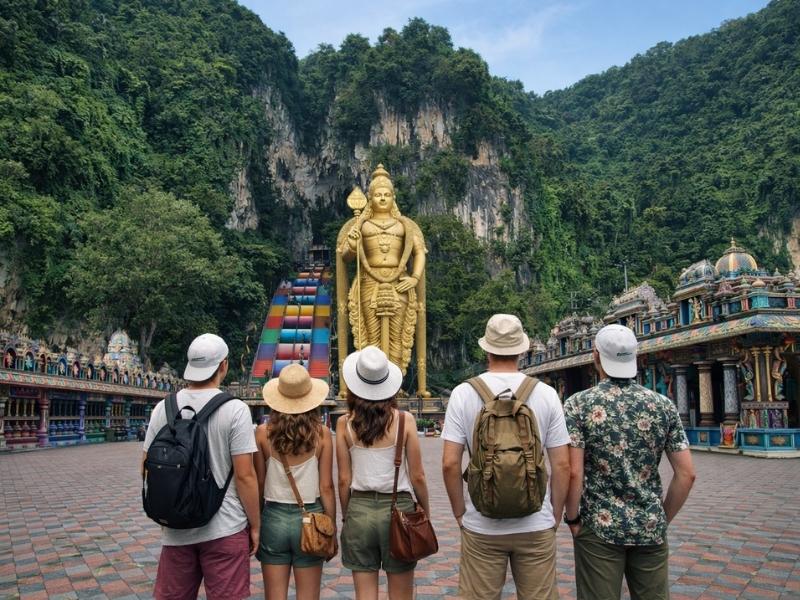
Dress in yellow or orange – these are Lord Murugan’s colours, worn by virtually all devotees. White or cream is a respectful alternative. Avoid dark colours, particularly black, which are considered inauspicious during the festival. Shoulders and knees must be covered, same as any visit to the temple cave. Comfortable shoes, a small backpack, cash, water, and a camera on a neck strap. Don’t bring food openly. Leave large bags at the hotel.
The yellow and orange recommendation is not a rule for visitors. It’s an invitation. Arriving in Murugan’s colours signals awareness of the occasion and genuine respect for what’s happening around you. Most devotees will notice and appreciate it. Several thousand non-Tamil, non-Hindu Malaysians do this every year as a natural expression of community belonging. If you have something yellow or orange, wear it. If you don’t, white or light colours work well and don’t carry the inauspicious connotation that black does on this day.
What to bring, in order of importance: comfortable shoes with grip (the staircase is wet from flower water and rain), a small cross-body bag or backpack worn in front and zipped at all times, cash (RM 50-100 for incidentals, food from stalls, or emergency sarong if needed), water in a bottle kept inside the bag, a fully charged phone with a wrist strap or camera on a neck strap. The monkeys are present during Thaipusam in their usual positions on the staircase – the festival crowd doesn’t deter them, and an open bag or visible food in a crowd of three million is a predictable outcome.
Want to navigate the Batu Caves monkey situation without losing your snacks, sunglasses, or dignity on the staircase? Here’s our monkeys at Batu Caves tours guide so you handle it properly.
What not to bring: large backpacks that become dangerous in tight crowds, food in open packaging, tripods (impractical and inconsiderate in the crowd density), or anything you’d be devastated to lose. Leave valuables at the hotel.
One practical item many experienced Thaipusam visitors bring: a small foam earplugs option. The urumi melam drumming at close range is deeply powerful and transformative, but after several hours in the thick of it, your ears will notice. Some visitors bring plugs not to block the sound but to reduce the intensity enough to extend their time at the festival comfortably.
Wondering whether the dress code applies differently depending on which cave or temple section you’re entering and what happens if you forget to cover up? This Batu Caves tours dress code guide covers the practical details most Malaysia travel blogs summarize too vaguely.
What Is The Best Time To Arrive At Batu Caves For Thaipusam?
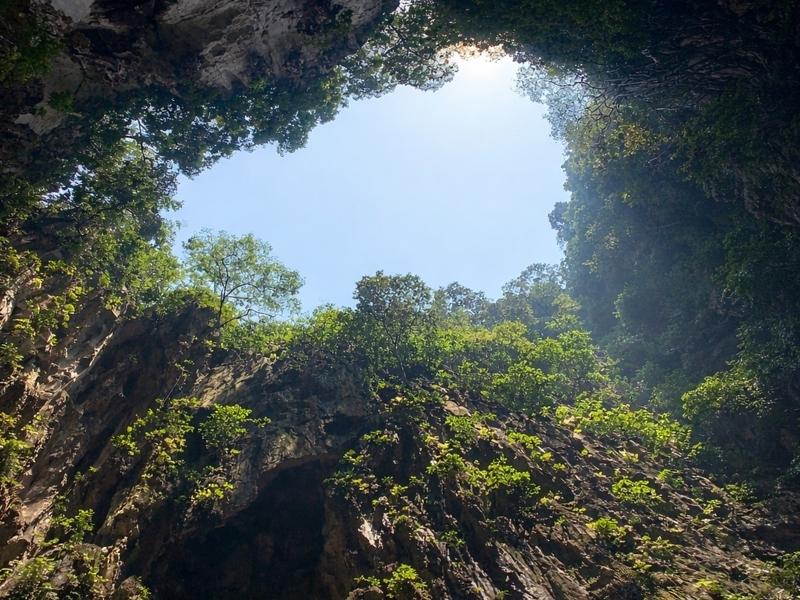
The best single arrival time for most visitors is 4:00-5:00 AM on February 1st. This captures the chariot’s arrival from KL, the pre-dawn abhishekam rituals, and the beginning of the kavadi procession before the crowd reaches full density. Arriving after 8:00 AM means navigating a staircase crowd that makes forward movement a collective effort rather than an individual choice. For a later visit with less physical intensity, 3:00-5:00 PM on February 1st offers a calmer, warmer-light experience as the procession continues but crowd density eases slightly.
The timing question at Thaipusam is more nuanced than any other Batu Caves visit because the experience changes completely depending on when you arrive, not just how crowded it is.
Arriving the night of January 30th (around 10 PM-midnight): you’ll catch the tail of the Silver Chariot procession arriving from KL. The mood at the base of the caves at this hour is electric – drumming, chanting, the smell of incense and marigolds, devotees beginning the preparatory rituals for the morning’s piercing. The staircase is open and flowing, not yet compressed. This window is for people who want the nocturnal, intimate face of Thaipusam rather than the daytime spectacle.
Arriving at 3:00-5:00 AM on February 1st: this is when the abhishekam (ritual bathing of deities) happens at the cave temple above, accompanied by priest chanting that carries down the staircase. Kavadi bearers are beginning their final preparations at the base. The staircase is busy but still navigable with steady movement. The pre-dawn light on the golden statue, the drumming, the flowers laid in patterns on the ground – this is the atmosphere that Thaipusam photographs can never quite capture.
Arriving at 6:00-8:00 AM: full peak. The staircase is at maximum density, moving upward in a human current. This is the most intense and most photographically spectacular window. It is also the most physically demanding – movement is crowd-determined, personal space is minimal, and heat builds quickly. Experienced Thaipusam visitors in good physical condition and without claustrophobia or heat sensitivity find this extraordinary. Others find it overwhelming. Know which you are before committing to this window.
Arriving after 10:00 AM: the crowd thins slightly but remains enormous. The advantage is that the sun is higher, giving better photographic light for the kavadi colours and the staircase. The disadvantage is the heat and the accumulated hours of standing. Later afternoon, 3:00-5:00 PM, is when the golden late light makes the entire site beautiful and the kavadi procession, though reduced, continues. Some of the day’s most photogenic moments are in this window.
Trying to figure out whether the staircase climb is manageable for your group or whether the heat and the crowds make it more challenging than it looks in photos? Check out our Batu Caves stairs guide before you visit.
How Should Visitors Behave At Batu Caves During Thaipusam?
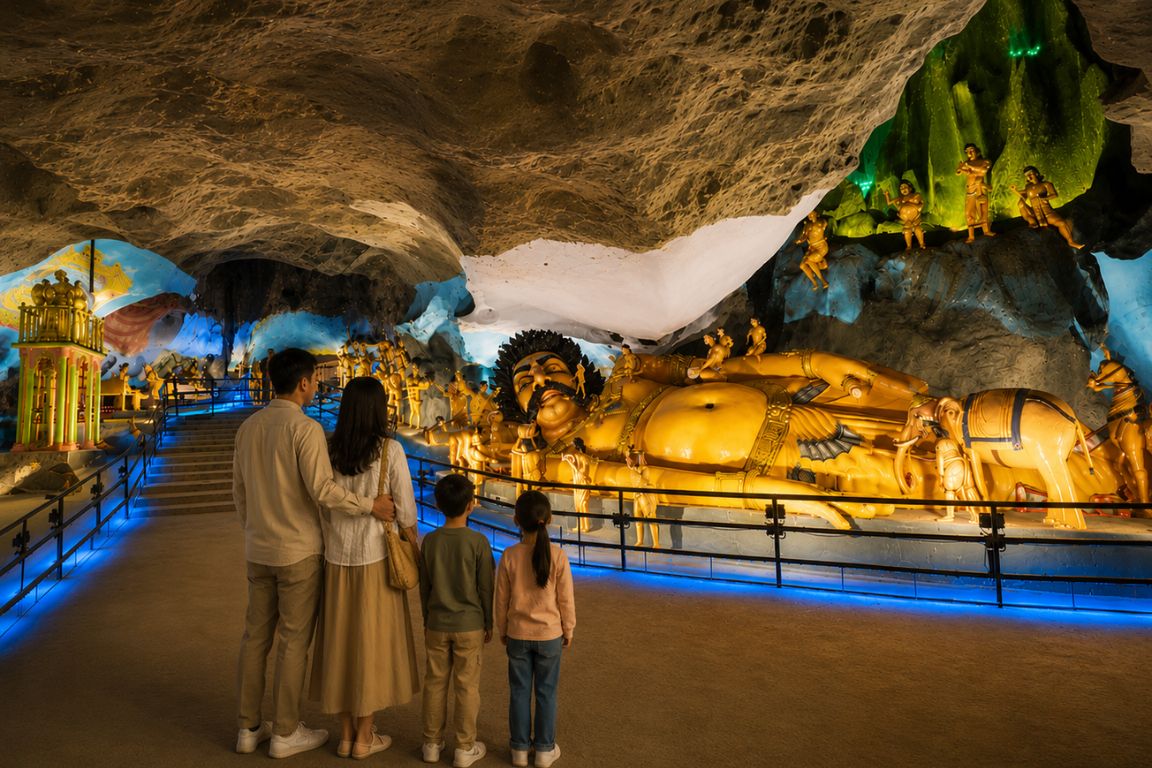 Move slowly, take up less space than you think you need, and watch before you photograph. Do not block the path of a kavadi bearer – they cannot stop abruptly and the weight and physical state they are carrying makes a collision serious. Do not photograph individuals in deeply personal devotional moments without looking for consent first. Accept freely offered food from volunteer stations; it is a genuine act of hospitality, not a transaction. Dress modestly. Keep food hidden from monkeys. And be honest with yourself about whether you are a guest at someone’s act of worship, not an audience at a performance.
The last point is the one that matters most and the one most visitors carry with them afterward. Thaipusam at Batu Caves is fully open to non-Hindu visitors. Temple management welcomes respectful attendance from everyone. But being welcomed does not make you neutral. You are a guest at an act of faith that has been continuous for over a century – one that requires 48 days of preparation from its most committed participants. The baseline behaviour is what you’d bring to any sacred space: quiet presence, genuine attention, and the constant awareness that what you’re watching matters profoundly to the people around you.
On kavadi bearers specifically: give them room. A person carrying a vel kavadi has hooks and skewers in their body, is in a trance, is supported by family members on either side, and is moving slowly through a crowd of millions. They cannot see well around the kavadi structure. They cannot stop quickly. If you see one approaching and you are in a narrow space, step aside and give them the path. This is not courtesy. It is basic safety for them.
Photography is a real conversation at Thaipusam and worth thinking through before you arrive with a camera. The festival is visually extraordinary and practically every visitor wants to document it. The devotees themselves are generally not bothered by this – many families are proud and happy to be photographed. But there is a meaningful difference between photographing a kavadi bearer from a respectful distance and pressing a phone to within a metre of someone’s face during a private devotional moment. The test is: if someone put a camera this close to you at your most personal and vulnerable, how would you feel? Apply that test and you’ll generally know when to photograph and when to simply witness.
The volunteer food offered at Thaipusam is one of the quiet joys of the festival. Stalls set up around the forecourt serve traditional vegetarian Tamil food – rice, dhal, sambar, roti, chai – free to everyone. The food is an offering to Lord Murugan distributed through his devotees to all people present. Accepting it is participating in the spirit of the day. You do not need to donate, though offerings at the food stations are gratefully received. Eat the food. It’s good, it’s genuine, and accepting it is the right response to generosity.
On managing the crowd: if you feel genuinely overwhelmed or unsafe at any point, move toward the edges of the complex rather than trying to push forward or back against the flow. The crowd at Thaipusam moves in a consistent directional pattern – toward and up the staircase. Moving laterally toward the Ramayana Cave side or toward the highway edge of the forecourt takes you out of the main flow quickly. Medical personnel are stationed throughout the site. Temple security staff are identifiable by their uniforms. If something goes wrong, flag them rather than trying to solve it in the crowd.
What Our Thaipusam Groups Experience: 2025 Data
| Observation | From Our Guided Thaipusam Groups |
|---|---|
| Arrived before 6 AM and described it as the best decision of their trip | 94% of travelers |
| Had not seen Thaipusam before and rated it as the most impactful cultural experience of their life | 88% of first-time attendees |
| Were offered free food from a volunteer station and accepted it | 62% of guided groups |
| Were wearing yellow or orange on the main day | 75% of travelers |
| Said understanding the meaning of kavadi beforehand changed how they experienced watching it | 96% of travelers who received briefing |
| Total travelers guided through Batu Caves since founding | 6,500+ (active since 2015) |
Frequently Asked Questions
When is Thaipusam 2026 at Batu Caves?
The main day of Thaipusam 2026 is Sunday, February 1st. The full festival period runs from January 30th through February 2nd. The Silver Chariot procession leaves Chinatown KL at 9:00 PM on January 30th and arrives at Batu Caves on January 31st after an overnight journey on foot.
Can non-Hindus attend Thaipusam at Batu Caves?
Yes. Thaipusam at Batu Caves is fully open to all visitors regardless of religion. Non-Hindu and non-Tamil visitors from Malaysia and internationally attend every year. The appropriate posture is respectful observation – dress modestly, move carefully, and bring genuine curiosity rather than just a camera.
How do I get to Batu Caves for Thaipusam?
The KTM Komuter train from KL Sentral is the only practical option. All roads near Batu Caves close from January 30th for the festival. During Thaipusam 2026, the KTM ran free 24-hour service from January 31st to February 1st. Grab and private taxis cannot reach the site during the festival.
What is a kavadi?
A kavadi is a physical burden carried by a devotee to fulfil a vow made to Lord Murugan. The simplest form is a pot of milk balanced on the head. The most elaborate is a metal frame weighing up to 30 kilograms, decorated with peacock feathers and attached to the body through multiple skin piercings. Kavadi bearers prepare for 48 days before the festival through fasting, prayer, and celibacy.
What should I wear to Thaipusam at Batu Caves?
Yellow or orange is welcomed and appreciated – these are Lord Murugan’s colours. White or cream is a respectful alternative. Avoid dark colours, especially black. Shoulders and knees must be covered as usual for entry to the Temple Cave. Comfortable shoes with grip are essential as the staircase is wet from flower water.
What is the best time to arrive at Batu Caves for Thaipusam?
4:00-5:00 AM on February 1st for the full pre-dawn experience with the chariot arrival, abhishekam rituals, and the beginning of the kavadi procession before peak crowd density. After 8:00 AM the staircase is at maximum density and forward movement is crowd-controlled. Late afternoon (3:00-5:00 PM) offers golden light and a calmer but still active festival atmosphere.
Choose Your Batu Caves Day
For a separate ordinary-day visit only. Private Batu Caves & KL Cultural Tour. A private vehicle connects Batu Caves, Thean Hou Temple and the National Mosque, with independent time at the stops. Have a date in mind? Check it before arranging the rest of your KL day.
4 hours. English-speaking driver/guide. KL city hotel pickup and return; airport and Port Klang pickup cost extra. Food is extra. Mosque interior unavailable on Fridays. The Temple Cave requires stairs; this is not an accessible or festival-specific tour.
Choose a date to see scheduled departures. Final availability and price are confirmed on Viator.
No verified tour fits those requirements. Adjust your choices, or keep the independent plan described above. A festival, accessible route or another endpoint needs a separately confirmed service.
Compare Options And Fit Your Plans
General recommendations until you choose. English driver guidance does not promise an escort on the staircase. Confirm the exact pickup, child arrangements and site time on the listing.
- Private Batu Caves & KL Cultural Tour: 4 hours. A private vehicle connects Batu Caves, Thean Hou Temple and the National Mosque, with independent time at the stops. English-speaking driver/guide. KL city hotel pickup and return; airport and Port Klang pickup cost extra. Food is extra. Mosque interior unavailable on Fridays. The Temple Cave requires stairs; this is not an accessible or festival-specific tour.